
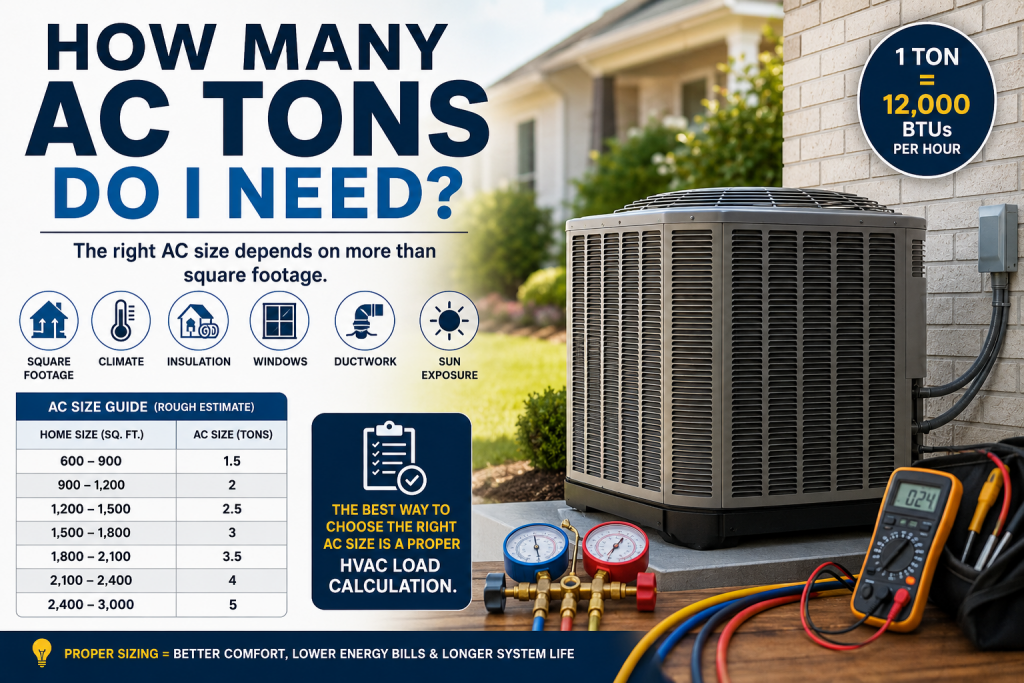
Most homes need somewhere between 1.5 and 5 tons of cooling capacity, but the right AC size depends on more than square footage alone. Climate, insulation, ceiling height, window exposure, ductwork, air leaks, and the layout of the home or shop all affect how many AC tons you need.
A quick AC sizing chart can help you estimate where to start, but it should not be used as the final decision. The best way to choose the correct air conditioner size is with a proper HVAC load calculation, often called a Manual J calculation for residential systems.
Choosing the right size matters. An undersized AC unit may run constantly and struggle to keep up, while an oversized unit can short cycle, waste energy, and fail to remove humidity properly. This guide explains what AC tonnage means, how it relates to BTUs, and what factors should be considered before selecting a system.
What Does AC Tonnage Mean?
AC tonnage measures cooling capacity, not the physical weight of the air conditioner. When someone refers to a “3-ton AC unit,” they are talking about how much heat the system can remove from a space in one hour.
The basic conversion is:
| AC Tonnage | Cooling Capacity |
|---|---|
| 1 ton | 12,000 BTUs per hour |
| 2 tons | 24,000 BTUs per hour |
| 3 tons | 36,000 BTUs per hour |
| 4 tons | 48,000 BTUs per hour |
| 5 tons | 60,000 BTUs per hour |
A BTU, or British Thermal Unit, measures heat energy. In air conditioning, BTUs describe how much heat an AC system can remove from indoor air. The higher the BTU rating, the more cooling capacity the unit provides.
How Many AC Tons Do I Need?
As a rough starting point, many homeowners estimate AC size based on square footage. For example, a smaller home may need around 1.5 to 2 tons of cooling, while a larger home may need 4 or 5 tons.
However, square footage alone should not be used as the final sizing method. Two homes with the same floor area can have very different cooling needs depending on insulation, sun exposure, windows, ductwork, and climate.
Here is a general AC sizing guide:
| Home Size / Area | Rough AC Size Estimate |
|---|---|
| 600–900 sq. ft. | 1.5 tons |
| 900–1,200 sq. ft. | 2 tons |
| 1,200–1,500 sq. ft. | 2.5 tons |
| 1,500–1,800 sq. ft. | 3 tons |
| 1,800–2,100 sq. ft. | 3.5 tons |
| 2,100–2,400 sq. ft. | 4 tons |
| 2,400–3,000 sq. ft. | 5 tons |
These ranges are only rough estimates. A shaded, well-insulated home may need less cooling capacity than a sunny, poorly insulated home of the same size. A garage, workshop, or commercial space may also need a different calculation because of equipment heat, open doors, ventilation, and layout.
Why Square Footage Alone Is Not Enough
Square footage is useful for a quick estimate, but it does not tell the whole story. Cooling load is affected by many conditions inside and outside the building.
Important factors include:
| Cooling Load Factor | Why It Matters |
|---|---|
| Local climate | Hotter climates usually require more cooling capacity. |
| Insulation quality | Poor insulation allows heat to enter more easily. |
| Ceiling height | Taller ceilings increase the volume of air that must be cooled. |
| Windows | Large or older windows can increase heat gain. |
| Sun exposure | South- or west-facing rooms may get hotter during the day. |
| Home orientation | The direction the building faces affects heat exposure. |
| Duct condition | Leaky or undersized ducts can reduce system performance. |
| Air leaks | Gaps around doors, windows, and attic spaces increase cooling demand. |
| Occupants | More people create more internal heat. |
| Appliances | Ovens, computers, compressors, and shop equipment add heat. |
| Multi-story layout | Upper floors often need more cooling than lower floors. |
| Room additions | Converted garages, basements, or additions may change the load. |
This is why a professional HVAC sizing method looks at the specific building, not just the floor area.
What Is a Manual J Load Calculation?
A Manual J load calculation is a professional HVAC sizing method used to estimate how much heating and cooling a building needs. It considers the home’s size, layout, insulation, windows, doors, ductwork, climate, air leakage, and other factors.
For central air conditioning, a Manual J calculation is the preferred way to choose the correct AC tonnage. It helps avoid the common mistake of choosing a system based only on the size of the previous unit or a basic square-foot rule.
If you are replacing a central AC system, do not assume the old unit was sized correctly. The previous system may have been oversized, undersized, or installed before insulation, windows, ductwork, or room layouts changed.
What Happens If Your AC Is Too Small?
An undersized AC unit may not have enough capacity to keep up with the cooling demand. This can become especially noticeable during peak summer heat or when the building has poor insulation, leaky ducts, or high sun exposure.
Common signs of an undersized AC unit include:
| Sign | What It May Mean |
|---|---|
| Runs constantly | The system is struggling to reach the thermostat setting. |
| Cannot cool the home | Cooling capacity may be too low for the space. |
| Uneven temperatures | Some rooms may not receive enough conditioned air. |
| Warm or humid rooms | The system may not be removing enough heat or moisture. |
| Higher energy use | Long run times can increase electricity consumption. |
| More wear on the compressor | Constant operation can shorten equipment life. |
| Poor performance during extreme heat | The unit may not keep up on the hottest days. |
A constantly running AC is not always undersized, though. It could also have airflow restrictions, low refrigerant, duct leakage, dirty filters, thermostat issues, or maintenance problems. That is why testing and diagnostics are important before replacing equipment.
What Happens If Your AC Is Too Large?
Bigger is not always better. An oversized AC unit can create comfort and efficiency problems because it cools the air too quickly and shuts off before completing a proper cooling cycle.
Common oversized AC problems include:
| Problem | Why It Happens |
|---|---|
| Short cycling | The system turns on and off too frequently. |
| Poor humidity control | The unit does not run long enough to remove moisture. |
| Uneven temperatures | Rooms may cool inconsistently. |
| Higher energy use | Frequent starts and stops waste energy. |
| More equipment wear | Components experience extra stress. |
| Higher upfront cost | Larger systems usually cost more to purchase. |
| Less consistent comfort | The home may feel cool but damp or clammy. |
An oversized AC may reach the thermostat setting quickly, but that does not mean it is doing the job well. Comfort depends on both temperature and humidity control.
AC Tons to BTUs: Quick Conversion Guide
When comparing air conditioner specs, you may see cooling capacity listed in tons or BTUs. Use this quick conversion guide:
| AC Tons | BTUs Per Hour |
|---|---|
| 1 ton | 12,000 BTU |
| 1.5 tons | 18,000 BTU |
| 2 tons | 24,000 BTU |
| 2.5 tons | 30,000 BTU |
| 3 tons | 36,000 BTU |
| 3.5 tons | 42,000 BTU |
| 4 tons | 48,000 BTU |
| 5 tons | 60,000 BTU |
This can help when comparing central air conditioners, mini-splits, package units, or replacement equipment.
How HVAC Pros Check Whether an AC System Is Sized Correctly
HVAC technicians do more than look at square footage. When checking whether a system is sized and performing correctly, they may review several parts of the system.
Common checks include:
| Check | Why It Matters |
|---|---|
| Load calculation results | Confirms the actual cooling requirement. |
| System tonnage | Verifies the installed equipment size. |
| Airflow | Poor airflow can reduce performance. |
| Temperature split | Measures the difference between return and supply air. |
| Duct sizing and leakage | Leaky or undersized ducts can make a system perform poorly. |
| Refrigerant charge | Incorrect charge affects cooling capacity and efficiency. |
| Static pressure | Helps identify airflow restrictions. |
| Thermostat behavior | Confirms proper control and cycling. |
| Humidity levels | Shows whether the system is removing moisture properly. |
| Equipment condition | Worn or dirty components can reduce performance. |
A correctly sized system can still perform like the wrong size if the airflow, refrigerant charge, ductwork, or controls are not working properly.
Tools Used for AC Sizing, Testing, and Service
HVAC technicians use specialized tools to size, test, diagnose, and service AC systems. These tools help confirm whether a system is operating properly and whether performance problems are caused by sizing, airflow, refrigerant, electrical, or duct issues.
Common AC service tools include:
| Tool | Used For |
|---|---|
| Manifold gauges | Checking refrigerant pressures. |
| Digital pressure and temperature analyzers | Advanced AC diagnostics and system readings. |
| Thermometers | Measuring supply and return air temperatures. |
| Vacuum pumps | Evacuating AC systems during service. |
| Leak detection tools | Finding refrigerant leaks. |
| Refrigerant scales | Charging systems accurately by weight. |
| Airflow tools | Measuring air movement and system performance. |
| Multimeters | Testing voltage, resistance, and electrical components. |
| Circuit testers | Checking electrical circuits and connections. |
| AC adapters and fittings | Connecting service equipment to AC systems. |
| AC tools and accessories | Supporting repair, maintenance, and diagnostics. |
For technicians and advanced DIY users, having the right tools is essential. Testing helps avoid guessing, especially when a system appears oversized, undersized, low on refrigerant, or restricted by airflow problems.
When Should You Call an HVAC Professional?
You should call an HVAC professional when the AC size or system performance affects comfort, safety, electrical components, refrigerant handling, or major equipment replacement.
Professional help is recommended when:
| Situation | Why Professional Help Matters |
|---|---|
| Replacing a central AC system | Correct sizing protects comfort and efficiency. |
| Adding AC to a home or shop | A load calculation helps determine the right capacity. |
| Finishing a basement, garage, or addition | New spaces can change the cooling load. |
| The AC runs constantly | The issue may be sizing, airflow, refrigerant, or duct related. |
| Rooms cool unevenly | Ductwork or airflow may need testing. |
| The system short cycles | The unit may be oversized or have a control issue. |
| Humidity remains high | The system may not be running long enough. |
| Energy bills increase suddenly | Performance problems may be driving higher usage. |
| Refrigerant testing is needed | Refrigerant work requires proper tools and training. |
| Electrical testing is needed | Electrical diagnostics should be handled safely. |
| Ductwork may be leaking | Duct problems can reduce system capacity. |
Sizing central AC equipment is not just a DIY square-foot calculation. A professional load calculation and system inspection can help prevent costly mistakes.
Browse AC Tools and HVAC Service Equipment
Whether you are diagnosing an existing system, checking refrigerant pressures, testing electrical components, or preparing for AC service work, the right tools make a difference.
You can find a wide selection of professional AC tools and HVAC service equipment at National Tool Warehouse, including diagnostic tools, manifold sets, vacuum pumps, leak detection tools, refrigerant scales, multimeters, circuit testers, and alternative service equipment to support accurate AC testing, repair, and maintenance.
FAQs
How many AC tons do I need for my house?
The number of AC tons you need depends on square footage, climate, insulation, windows, ceiling height, sun exposure, ductwork, and layout. A rough estimate can help, but a professional load calculation is the best way to confirm the correct size.
How many BTUs are in one ton of AC?
One ton of AC equals 12,000 BTUs per hour. A 3-ton AC unit provides about 36,000 BTUs per hour of cooling capacity.
Is a bigger AC unit better?
No. An oversized AC unit can short cycle, waste energy, create uneven temperatures, and remove less humidity from the air.
What happens if my AC is too small?
An undersized AC may run constantly, struggle to reach the thermostat setting, cool unevenly, and wear out faster during high-demand periods.
Can I size an AC unit by square footage?
Square footage can provide a rough estimate, but it should not be the only factor. Insulation, climate, windows, ceiling height, ductwork, and sun exposure can change the cooling load significantly.
What is the best way to calculate AC size?
The best way to calculate AC size is with a professional HVAC load calculation, often referred to as a Manual J calculation for residential systems.