
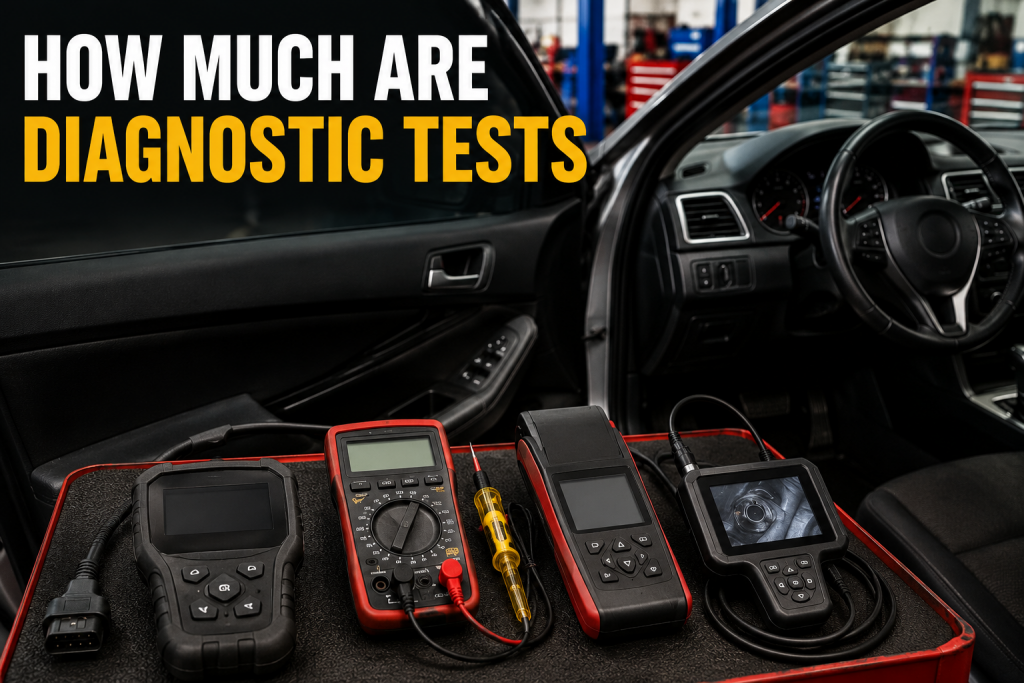
Car diagnostic tests can range from a basic code scan to a more detailed inspection by a professional technician. The cost depends on the shop, the vehicle, the issue, and whether additional testing is needed beyond reading a trouble code.
A diagnostic test is commonly used when a vehicle has a check engine light, electrical issue, no-start problem, rough idle, battery concern, sensor fault, or performance complaint. While some drivers search for the cheapest diagnostic option, the real value of a diagnostic test is that it helps identify the actual issue before money is spent replacing the wrong parts.
For DIY users, basic diagnostic tools can help with simple checks at home. For more complex problems, a professional diagnostic test may be the better option because it includes technician experience, advanced tools, and system-specific troubleshooting.
How Much Are Car Diagnostic Tests?
Many shops charge a diagnostic fee, and the final cost depends on how much time is needed to confirm the problem. A basic code scan may be low-cost or sometimes offered free by some parts stores, but a professional diagnostic test at a repair shop usually costs more because it includes more than just plugging in a scanner.
A professional diagnostic test may include technician time, scan tool use, visual inspection, live data review, electrical testing, and additional troubleshooting. If the issue is simple, the diagnostic process may be quick. If the issue is intermittent, electrical, or tied to multiple systems, the diagnosis may take longer.
In short, the answer to “how much are diagnostic tests?” depends on the depth of testing required. A quick code scan and a full diagnostic inspection are not the same service.
What Is Included in a Car Diagnostic Test?
A car diagnostic test is designed to help identify the cause of a warning light, performance problem, or system fault. The exact process depends on the issue, but it may include several checks.
A diagnostic test may include:
| Diagnostic Step | What It Helps Identify |
|---|---|
| Connecting a scan tool | Communicates with the vehicle’s onboard computer |
| Reading diagnostic trouble codes | Shows stored fault codes |
| Reviewing live data | Displays real-time sensor and system information |
| Checking freeze-frame data | Shows vehicle conditions when the code was triggered |
| Inspecting related systems | Helps confirm what may be causing the fault |
| Testing sensors | Checks whether a sensor is working correctly |
| Testing wiring or fuses | Helps find electrical faults |
| Checking battery performance | Identifies weak battery or charging-system issues |
| Confirming the likely cause | Reduces the risk of replacing the wrong part |
An important point to remember is that a trouble code does not always identify the exact part that needs replacing. A code points the technician toward the system, circuit, or condition that needs further testing.
For example, an oxygen sensor code does not automatically mean the oxygen sensor is bad. The issue could be wiring, an exhaust leak, a fuel mixture problem, or another related fault.
Why Do Diagnostic Test Prices Vary?
Diagnostic pricing varies because not every vehicle issue requires the same amount of time, equipment, or testing. Some problems are straightforward, while others require deeper troubleshooting.
The Type of Problem
A check engine light may be quick to scan, especially if the problem is common and easy to reproduce. However, electrical faults, intermittent issues, drivability problems, and no-start conditions can take more time.
For example, a loose gas cap and an intermittent wiring fault are very different diagnostic jobs. One may be identified quickly, while the other may require testing circuits, checking live data, and recreating the problem.
Vehicle Make and Model
Some vehicles require more advanced scan tools or system-specific diagnostics. Newer vehicles often have multiple control modules, advanced sensors, driver-assist systems, and manufacturer-specific codes.
A basic OBD2 scan may read engine-related codes, but it may not access ABS, airbag, transmission, body control, or manufacturer-specific systems.
Basic Code Scan vs Full Diagnosis
A basic code scan reads stored diagnostic trouble codes. A full diagnosis goes further.
| Basic Code Scan | Full Diagnostic Test |
|---|---|
| Reads stored codes | Reads codes and interprets them |
| May clear codes | Reviews live and freeze-frame data |
| Limited troubleshooting | Tests related systems |
| Usually quick | May require technician time |
| Does not always confirm the cause | Helps verify the likely fault |
A code scan is useful, but it is only the starting point.
Shop Labor Rate
Professional shops charge for technician time, experience, equipment, and overhead. A skilled technician is not only reading a code; they are interpreting the data, checking related components, and confirming the cause before repair work begins.
Additional Testing
Some vehicle problems require tools beyond a scan tool. Additional testing may involve:
| Tool | Common Use |
|---|---|
| Multimeter | Testing voltage, resistance, and continuity |
| Circuit tester | Checking power and ground |
| Fuel pressure tester | Testing fuel delivery issues |
| Smoke machine or leak tester | Finding vacuum or evaporative leaks |
| Inspection camera | Viewing hard-to-reach areas |
| Battery tester | Checking battery and charging-system health |
When additional testing is needed, the diagnostic process may take longer.
Is a Free Code Scan the Same as a Diagnostic Test?
No. A free code scan is not the same as a full diagnostic test.
A free code scan can tell you which diagnostic trouble codes are stored in the vehicle’s computer. That information can be helpful, but it does not always confirm the exact cause of the problem. A professional diagnostic test usually goes further by interpreting the code, checking related systems, and verifying the fault before parts are replaced.
For example, a code related to an oxygen sensor may be caused by:
| Possible Cause | Why It Matters |
|---|---|
| Bad oxygen sensor | The sensor itself may have failed |
| Damaged wiring | The sensor may not be receiving or sending the correct signal |
| Exhaust leak | Extra oxygen may affect sensor readings |
| Fuel mixture issue | The engine may be running too rich or too lean |
| Vacuum leak | Unmetered air may affect engine performance |
| Related engine issue | Another fault may be triggering the code |
Replacing the oxygen sensor without testing could waste money if the real problem is wiring or a fuel mixture issue.
Common Reasons Drivers Pay for Diagnostic Testing
Drivers usually pay for diagnostic testing when there is a warning light, performance issue, or system problem that cannot be confirmed by a visual inspection alone.
Common reasons include:
| Vehicle Issue | Why Diagnosis Helps |
|---|---|
| Check engine light | Identifies stored trouble codes and related systems |
| Rough idle | Helps find misfires, vacuum leaks, or sensor issues |
| Poor acceleration | Checks fuel, ignition, airflow, or transmission concerns |
| No-start condition | Tests battery, starter, fuel, ignition, and electrical systems |
| Battery warning light | Checks charging-system performance |
| ABS warning light | Reads brake system fault information |
| Airbag warning light | Helps identify SRS system faults |
| Transmission shifting issues | Reviews transmission codes and live data |
| Overheating | Checks cooling-system and sensor issues |
| Poor fuel economy | Helps locate fuel, sensor, or engine performance faults |
| Misfires | Identifies cylinder, ignition, fuel, or compression-related problems |
| Electrical faults | Tests wiring, fuses, circuits, and modules |
| Sensor issues | Confirms whether sensors are faulty or being affected by another problem |
A diagnostic test helps narrow the problem so the repair can be more accurate.
Can You Run a Diagnostic Test Yourself?
Yes, DIY users can perform basic diagnostic checks with the right tools. A home diagnostic test can help you understand why a warning light is on, check simple issues, and decide whether a professional repair is needed.
However, DIY diagnostics are not a replacement for professional diagnosis in every case. Complex electrical faults, safety-related issues, intermittent problems, and expensive repairs may require advanced equipment and experience.
OBD2 Code Readers
An OBD2 code reader is one of the most useful tools for basic DIY diagnostics. It plugs into the vehicle’s OBD2 port and reads stored trouble codes.
A code reader can help with:
| Use | Benefit |
|---|---|
| Reading check engine light codes | Helps identify the affected system |
| Clearing codes | Useful after repairs or testing |
| Checking emissions readiness | Helpful before inspections |
| Viewing basic code definitions | Gives a starting point for troubleshooting |
Code readers are great for basic checks, but they may not provide advanced live data or access to other vehicle systems.
Scan Tools
Scan tools are more advanced than basic code readers. Depending on the tool, they may show live data, freeze-frame data, ABS/SRS information, transmission codes, and manufacturer-specific details.
Advanced scan tools are useful for DIY users who work on vehicles often, as well as technicians and shops that need deeper diagnostic access.
Multimeters
A multimeter is useful for electrical testing. It can measure voltage, resistance, and continuity.
Common automotive uses include:
| Multimeter Use | Example |
|---|---|
| Battery voltage testing | Checking battery condition |
| Fuse testing | Confirming whether a fuse has power |
| Sensor testing | Checking electrical signals |
| Continuity testing | Finding breaks in a circuit |
| Charging-system checks | Testing alternator output |
Many problems that appear to be sensor failures are actually wiring, ground, or voltage issues. A multimeter helps confirm what is happening.
Circuit Testers
Circuit testers are helpful for checking power and ground in automotive circuits. They are often used for lights, fuses, switches, relays, and basic wiring checks.
A circuit tester can be useful when diagnosing electrical accessories, lighting issues, and no-power conditions.
Battery Testers
Battery testers help check battery health and charging-system condition. They are useful for diagnosing slow cranking, no-start problems, battery warning lights, and electrical concerns.
A weak battery can cause confusing symptoms, so battery testing is often one of the first checks in a diagnostic process.
When Should You Use a Professional Diagnostic Test?
DIY tools are useful, but some situations call for professional diagnosis. A shop has access to advanced scan tools, service information, specialty equipment, and technicians who diagnose problems regularly.
Use a professional diagnostic test when:
| Situation | Why Professional Diagnosis Matters |
|---|---|
| The issue is safety-related | Brakes, steering, airbags, and drivability issues need caution |
| The check engine light is flashing | This may indicate a serious misfire or engine risk |
| The car has drivability problems | Stalling, hesitation, or power loss may need deeper testing |
| The vehicle will not start | Multiple systems may need to be checked |
| The same code keeps returning | The root cause may not have been fixed |
| Wiring or control modules are involved | Electrical diagnosis can be complex |
| The repair could be expensive | Guessing can cost more than testing |
| You do not have the correct tools | Some faults need advanced equipment |
| You are not confident in the repair | A technician can confirm the likely cause |
Professional diagnosis is especially valuable when replacing parts would be expensive or when the wrong repair could create additional problems.
How Diagnostic Tools Can Help Save Money
Diagnostic tools can help save money by reducing guesswork. Instead of replacing parts based only on symptoms, users can gather information, test related systems, and confirm whether a repair solved the issue.
Diagnostic tools can help users:
| Benefit | How It Helps |
|---|---|
| Understand warning lights | Shows why a check engine light may be on |
| Avoid replacing the wrong parts | Helps identify the system before buying parts |
| Check simple issues first | Battery, fuse, and wiring checks can be done early |
| Confirm repairs | Codes and live data can show whether the issue is resolved |
| Monitor recurring problems | Helps track faults that come back over time |
| Support maintenance | Useful for battery, charging, and performance checks |
For home garage users, a basic code reader and multimeter can be a smart starting point. For shops and advanced users, professional diagnostic tools can improve speed, accuracy, and confidence.
What Diagnostic Tools Should You Keep in a Garage?
The right diagnostic tools depend on how much vehicle work you do. A basic DIY setup may only need a few tools, while a professional shop needs more advanced equipment.
For Basic DIY Use
A basic garage diagnostic kit may include:
| Tool | Why It Is Useful |
|---|---|
| OBD2 code reader | Reads check engine light codes |
| Multimeter | Tests voltage, resistance, and continuity |
| Circuit tester | Checks power and ground |
| Battery tester | Checks battery and charging-system condition |
| Inspection light | Improves visibility during checks |
This setup is helpful for basic warning light checks, battery issues, simple electrical problems, and general troubleshooting.
For Advanced DIY or Shop Use
Advanced DIY users and professional shops may need more complete diagnostic equipment, including:
| Tool | Why It Is Useful |
|---|---|
| Professional scan tool | Accesses more systems and live data |
| Advanced diagnostic scanner | Supports deeper troubleshooting |
| Fuel pressure tester | Checks fuel delivery problems |
| Smoke machine or leak tester | Finds vacuum and evaporative leaks |
| Inspection camera or borescope | Views hard-to-reach areas |
| Pressure and temperature testing tools | Helps diagnose performance and HVAC issues |
| Heavy-duty diagnostic tools | Useful for trucks, fleets, and commercial vehicles |
The more complex the vehicle system, the more important it becomes to have the right diagnostic equipment.
Browse Diagnostic Tools at National Tool Warehouse
Diagnostic testing is not just about finding a code. It is about understanding the problem before replacing parts. Whether you are a DIY user checking a warning light or a shop diagnosing vehicles daily, the right tools can help you work with more confidence.
You can find the right diagnostic tools at National Tool Warehouse, including scan tools, code readers, multimeters, circuit testers, battery tools, fuel injection tools, inspection cameras, and professional automotive diagnostic equipment.
FAQs
How much does a car diagnostic test usually cost?
The cost depends on the shop, vehicle, and problem being diagnosed. A basic code scan may be inexpensive, while a full professional diagnostic test usually costs more because it includes technician time and additional troubleshooting.
Is a diagnostic test worth it?
Yes. A diagnostic test can help identify the actual issue before parts are replaced, which may save money and prevent unnecessary repairs.
Can I do a car diagnostic test myself?
Yes, basic diagnostic checks can be done with an OBD2 code reader or scan tool. For electrical, fuel, or intermittent issues, additional tools and experience may be needed.
Is a code scan the same as a diagnostic test?
No. A code scan reads stored trouble codes, while a full diagnostic test may include live data, system testing, electrical checks, and technician interpretation.
Why do mechanics charge a diagnostic fee?
Mechanics charge diagnostic fees because proper diagnosis takes time, equipment, experience, and testing. The fee covers the process of finding the likely cause of the problem.
What tool do I need to diagnose a check engine light?
An OBD2 code reader or scan tool is usually the first tool used to diagnose a check engine light.