
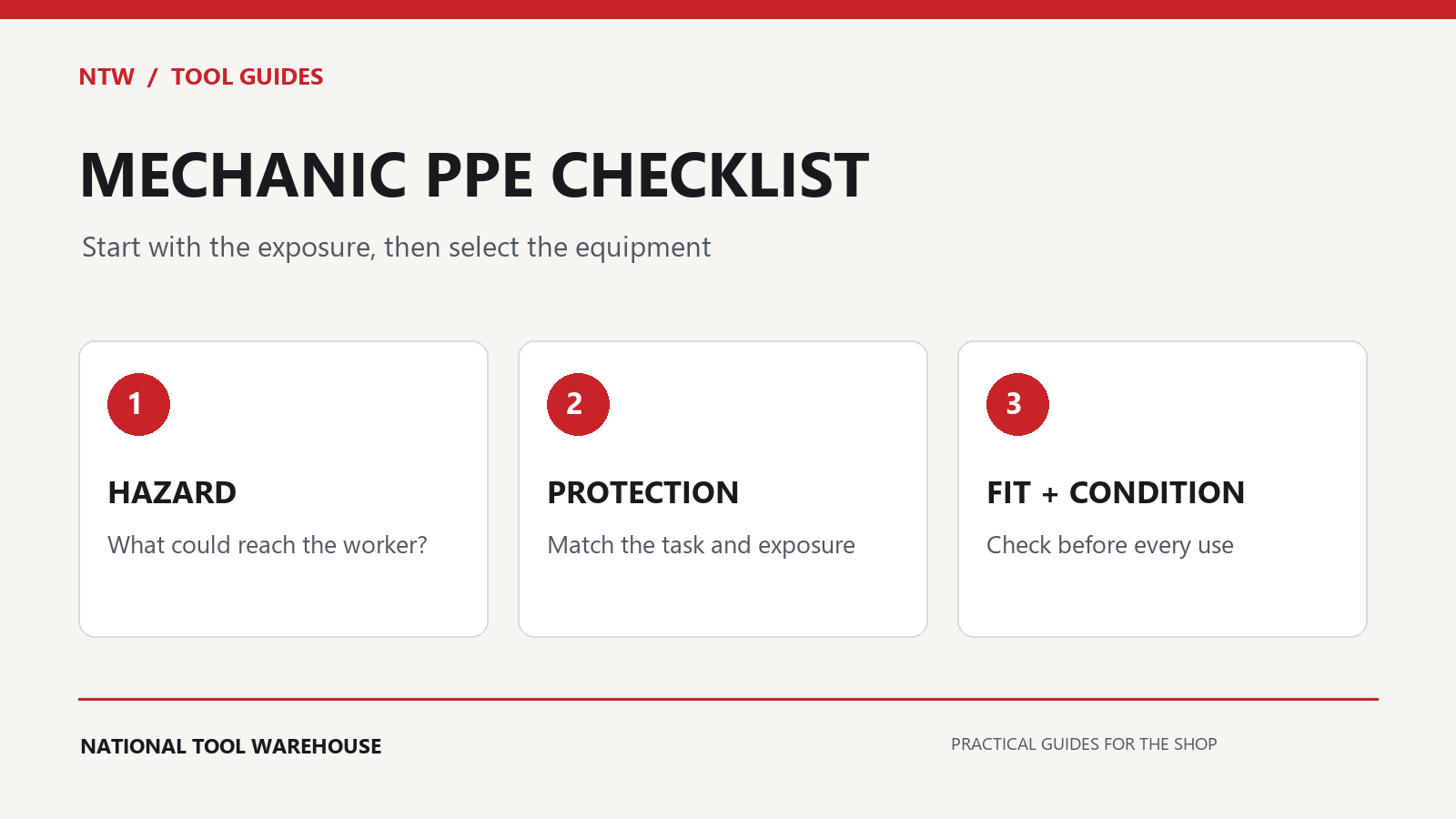
A mechanic PPE checklist is useful only when it matches the job. Moving a vehicle, handling a chemical, grinding a bracket and welding a panel expose people to different hazards. A drawer of gloves and safety glasses does not establish that the right protection has been selected.
Start with the workplace hazard assessment and the instructions for the tool, material and protective equipment. This guide organizes the questions to ask; it is not a universal PPE prescription. The responsible employer or safety professional must determine the requirements for the actual work.
Control the hazard before choosing PPE
OSHA’s PPE selection guidance describes protective equipment as part of a wider control approach. Guards, appropriate equipment, extraction and suitable work practices remain important. PPE should not be used as a reason to remove a guard or proceed with an uncontrolled process.
Write down the task and the exposure first. “Protect hands” is too vague: cuts, chemical contact, heat and moving parts require different decisions. Identify nearby workers as well as the operator, and consider the job’s changing conditions.
A task-based selection sheet
| Task or exposure | Selection questions | Pre-use check |
|---|---|---|
| Flying particles | What eye protection and additional face protection does the task require? | Lens condition, coverage and secure fit |
| Chemical handling | Which glove material and splash protection suit the actual chemical? | Material guidance, damage and replacement plan |
| Noise | What does the exposure assessment require? | Correct protector, fit and communication needs |
| Dust, spray or vapor | Can the process be controlled, and what respiratory protection is specified? | Approved selection and program requirements |
| Hot work | What eye, face, skin and clothing protection fits the process? | Required protection and condition of all layers |
| Foot hazards | What impact, puncture, slip or other hazard is present? | Suitable footwear and sole condition |
Eye and face protection work together
Select protection for the identified particle, splash or radiation hazard. Ordinary prescription glasses are not automatically suitable safety eyewear. OSHA’s assessment material also explains that a face shield is used with appropriate underlying eye protection for impact hazards; a shield alone should not be treated as the complete answer.
Check for scratched or damaged lenses, loose adjustment and interference with other equipment. If hearing protection or a respirator changes the fit, assess the full combination before the job. Comfort matters because equipment that repeatedly slips or obstructs the task will not be used consistently.
Gloves need a specific purpose
Use chemical compatibility and the manufacturer’s instructions when selecting chemical-resistant gloves. A familiar glove is not automatically suitable for every solvent, cleaner or exposure duration. Record what it was selected for and how the worker knows when replacement is needed.
For mechanical work, consider dexterity, sharp edges, heat and any entanglement risk. Follow the machine’s instructions; do not carry a generic “wear gloves” rule into a rotating-equipment task without assessing that hazard. Keep damaged or contaminated protection out of the usable supply.
Respiratory protection is a separate decision
A particle filter and a vapor-control approach address different hazards. Do not select a respirator by appearance or smell alone. The applicable assessment must establish the contaminant, exposure and suitable controls, including any required respiratory protection program.
Autobody spray work deserves particular attention. NIOSH identifies paint spray hazards and the need to coordinate equipment, ventilation and respiratory protection. Medical evaluation, fit testing where applicable, training and maintenance cannot be replaced by adding a disposable mask to the shopping list.
Before each job
- Name the task, material and credible exposure.
- Confirm the required process controls are in place.
- Select protection from the actual assessment and instructions.
- Check size, fit and compatibility of the complete combination.
- Inspect condition and replace unsuitable equipment.
- Know how to remove, clean, store or dispose of it correctly.
OSHA’s general PPE requirements address suitable selection, fit and training. A useful training check asks the worker to explain when the equipment is needed, what it cannot do and how it should be cared for. Record an unresolved selection issue before allowing the work to continue.
Keep the personal checklist separate from the shop inspection
This sheet follows the worker and task. A workplace inspection follows the bay, equipment and process. Use our toolbox talk guide to discuss a task-specific finding and browse the Shop Safety & Apparel guides for related context.
For welding-process planning, our MIG, TIG and stick comparison helps frame the job, while the selected equipment and process instructions determine the protection needed.
For garment options, browse NTW’s paint suits. Confirm the exact garment’s protection, limitations and fit against the task’s hazard assessment and the manufacturer’s instructions.
References
OSHA general PPE requirements; OSHA hazard-assessment and selection guidance; OSHA PPE assessment training material; NIOSH autobody overspray controls.