
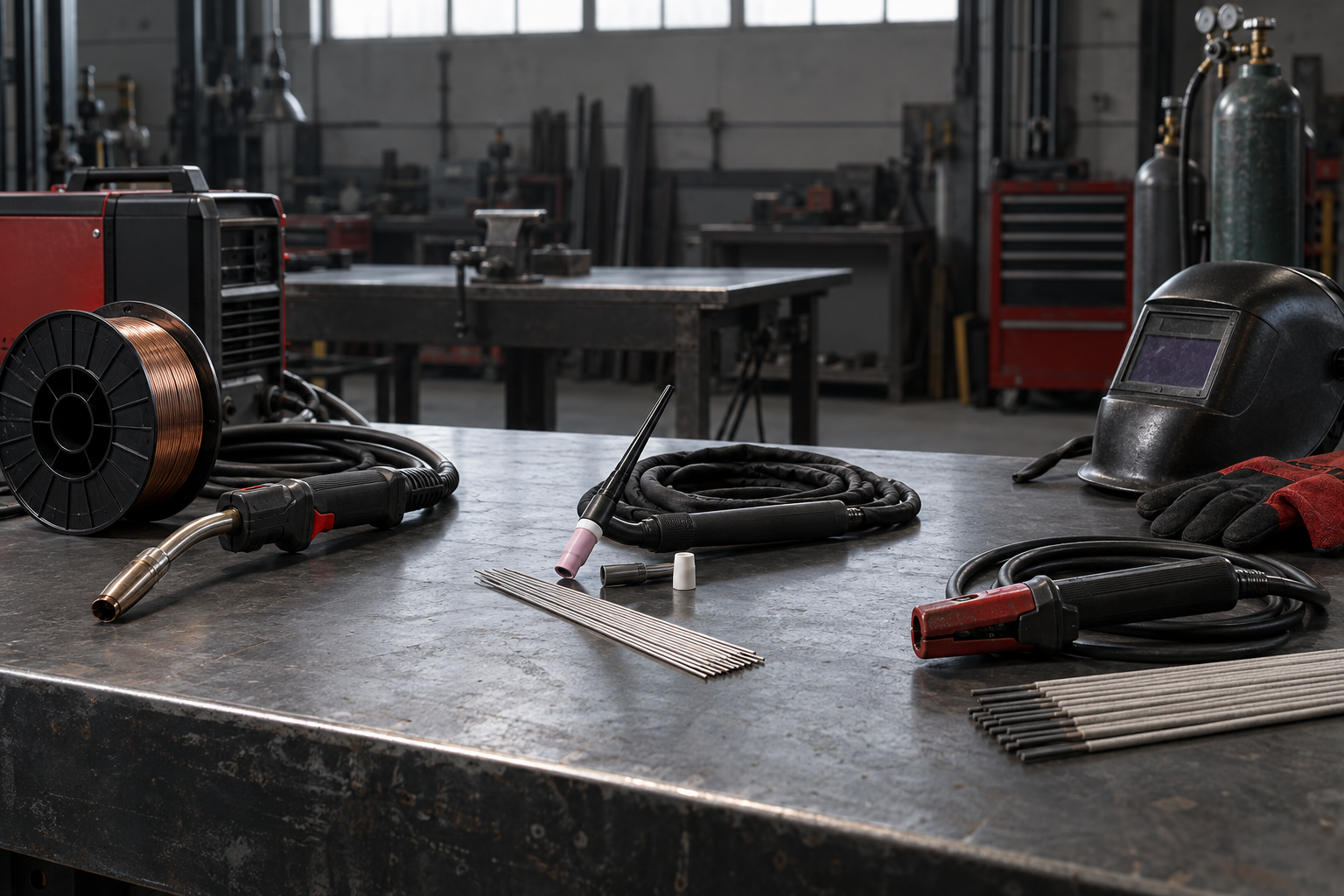
MIG, TIG and stick are names for different arc-welding processes, not quality rankings. The right choice depends on the material, joint, work location, required control and equipment you can support. A machine's label alone does not tell you whether it can weld a specific metal or thickness: check its process, output range, duty cycle, power requirements and approved consumables.
Compare the three processes
| Process | What makes the arc and supplies filler | Practical strength | Main trade-off |
|---|---|---|---|
| MIG / GMAW | A continuously fed solid wire serves as the electrode and filler; external shielding gas protects the weld. | Continuous wire feed supports efficient welding and is approachable for many new operators. | The machine, wire-feed system and shielding-gas setup add complexity; gas protection must suit the work area. |
| TIG / GTAW | A non-consumable tungsten electrode makes the arc; filler can be added separately when the joint requires it. Shielding gas protects the weld. | Precise control and low-spatter work, including thin material when the machine and technique are suitable. | Slower metal deposition and greater coordination/setup demands. |
| Stick / SMAW | A consumable flux-coated electrode provides filler and shielding as it burns. | Simpler, portable equipment and flexibility across jobs by selecting the appropriate electrode. | Electrodes must be changed and slag removed; thin material and appearance-sensitive work can demand more skill. |
These are process-level comparisons from Lincoln Electric's welding power-source guide. Actual results depend on the machine, consumable, joint preparation and operator. Flux-cored arc welding (FCAW) is a separate wire-feed process: some wire can self-shield while other wire needs gas. Do not assume a machine advertised as “gasless MIG” uses the same solid-wire GMAW setup shown in the table.
Choose by the job, not a single score
When MIG is a sensible starting point
Consider MIG when you expect repeated welds in a controlled shop setting and want the productivity of continuous wire feed. Confirm that the power source supports the metal, thickness and joint you actually plan to weld, and that you have the correct wire and shielding gas. If a unit also offers flux-cored welding, inspect the process and wire requirements separately. Browse NTW's MIG welding range as a product starting point; verify the individual welder's specifications before choosing one.
When TIG earns its slower pace
Consider TIG when controlled heat input and weld appearance matter more than deposition speed. The separate tungsten arc and optional filler give the operator fine control, but the process requires practice and careful setup. A TIG-capable label does not guarantee that a particular machine is configured for every metal, especially where output type or polarity differs. Compare the exact machine manual and consumables in the TIG welding range.
When stick suits the work
Consider stick when portability and a simpler equipment arrangement matter. The electrode coating supplies shielding, so ordinary SMAW does not rely on the external gas cylinder used by solid-wire MIG or TIG. Select the electrode for the base metal and joint and allow for slag removal and electrode changes. The stick welder range is a place to compare actual machines; do not infer a particular amperage or material rating from the category name.
Five checks before choosing a welder
- Material and joint: Identify the base metal, thickness, position and joint type. Follow the applicable procedure rather than assuming one process works on every job.
- Power and output: Confirm the available input supply and the machine's required output range for the chosen process and consumable.
- Duty cycle: Compare the manufacturer's rated duty cycle at the current you expect to use. A headline maximum output does not describe continuous welding capacity.
- Consumables and shielding: Price and source the correct wire, electrode or tungsten, plus gas where required. Check whether the machine includes a torch, regulator, leads and other needed parts.
- Work area and safety: Plan for electrical, fume, eye and burn hazards before welding. OSHA's welding hazards overview identifies fumes, ultraviolet radiation, burns and shock, and points to controls and protective equipment. Use the machine manual and the applicable workplace procedure.
Common questions
Is TIG always stronger than MIG or stick?
No process name alone determines weld strength. Material, joint design, preparation, filler, settings and procedure matter. Choose the process and qualified procedure for the job rather than using a blanket strength ranking.
Is flux-cored wire the same as MIG?
No. Both can use a wire feeder, but solid-wire GMAW uses external shielding gas, while FCAW uses flux-filled wire and may be self-shielded or gas-shielded. Check the exact wire and machine setup. Lincoln Electric's process guide distinguishes them.
Can one multiprocess machine replace three machines?
Sometimes, if it supports the required processes at the needed output and with the right accessories. Read its exact specification and manual. Process capability does not establish every material, thickness or duty-cycle capability.
Start with the full NTW welding range, then narrow to the actual process and check the exact welder and consumables before ordering.