
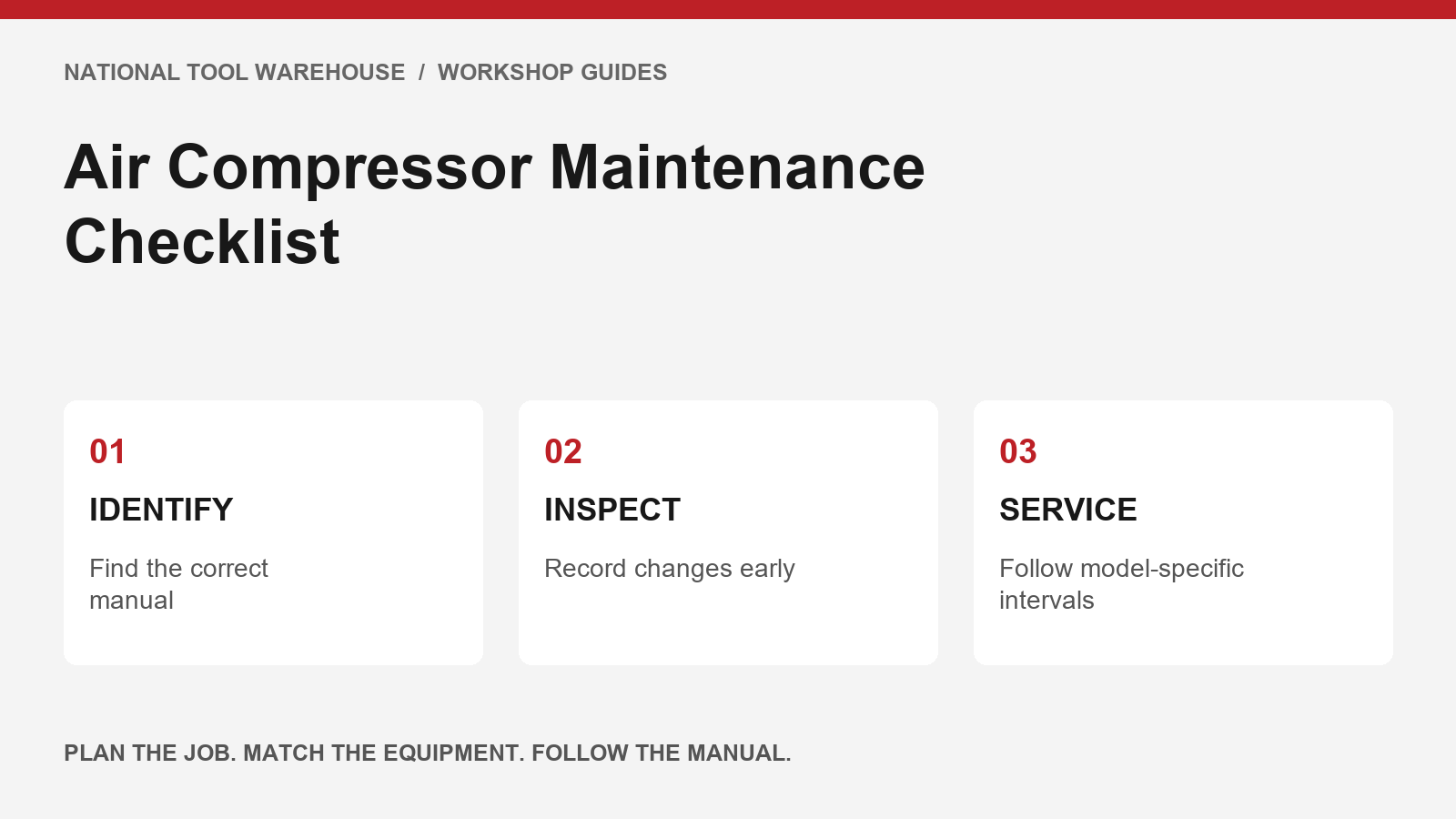
An air compressor maintenance checklist should turn the manufacturer’s service instructions into repeatable jobs with an owner and a record. It should not assign the same oil, belt adjustment or service interval to every machine. Start by identifying the compressor, then separate operator checks from work that needs a qualified service technician.
This guide is a planning framework for workshop compressed-air equipment. The model manual sets the actual methods, intervals, lubricant and parts. It does not provide a universal repair procedure for pressure vessels, electrical controls or safety devices.
Build the checklist from the nameplate
Record the manufacturer, model, serial number and pump type, along with operating hours where available. Identify whether the unit is oil-lubricated or oil-free and whether it is direct drive, belt drive or another design. Find the correct manual revision and service-parts list before ordering consumables.
Ingersoll Rand’s documentation library separates manuals by compressor family and model. That is a useful reminder that a portable reciprocating machine and a rotary screw system do not share one maintenance recipe. Keep the manual reference in the log so another operator can understand where each scheduled task came from.
Use a checklist with clear boundaries
| Check | What to record | What controls the action |
|---|---|---|
| Lubricant, where fitted | Level or condition observed using the prescribed method | Model lubricant and inspection instructions |
| Condensate management | Manual drain task or automatic-drain observation | Drain-system procedure and disposal requirements |
| Intake and cooling | Filter condition, obstructed vents or dirty cooling surfaces | Approved cleaning/replacement method |
| Hoses, guards and drive | Visible damage, missing guards, noise or vibration changes | Shutdown and service instructions |
| Scheduled service | Date, hours, parts and technician | Time/hour limits and operating environment |
Keep operator observations simple
Make the routine inspection easy to repeat: note abnormal noise, vibration, visible leakage, damaged hoses and blocked ventilation. On lubricated equipment, use the manual’s level-checking method. A reading taken under the wrong conditions can lead to an incorrect top-up. Oil-free does not mean inspection-free.
Quincy’s preventive-maintenance guidance includes checking indicators, fluid levels, leaks, noise and condensate, with different scheduled tasks for filters and cooling equipment. Use those as categories to organize your checklist; copy the actual frequency from your compressor manual and adjust through the manufacturer’s guidance for the operating conditions.
Manage condensate using the correct drain procedure
Compressed-air systems collect moisture that needs controlled removal. Identify the receiver drain and any downstream drains or separators. Record whether each drain is manual or automatic and how proper operation is checked. A quiet automatic drain is not proof it is clear or working.
Follow the equipment instructions for permitted pressure, shutdown and discharge direction. Collect and dispose of condensate appropriately, particularly where it may contain oil. Do not remove a drain fitting under pressure or improvise a method around a blocked or damaged valve. Arrange service when the normal procedure cannot be completed safely.
Separate inspection from hands-on service
A compressor can restart automatically and retain pressure after the motor stops. Before maintenance, follow the manufacturer’s isolation, cooling and pressure-release instructions and the workplace energy-control procedure. Switching the control off alone does not establish that equipment is safe to open.
Keep guards fitted during operation. Belt tension, pulley alignment, electrical checks and pressure-control work need the proper method and competence. Never change a pressure-switch setting to compensate for a fault, bypass a safety device or repair a damaged receiver by patching or welding it. Escalate damage or abnormal operation to qualified service.
Use the specified lubricant, filters and intervals
Identify the exact service part and lubricant specification before purchase. A similar-looking filter or an oil with a familiar viscosity number may not satisfy the machine’s requirements. Record what was fitted and why it matches. Our air compressor oil guide explains the selection questions without treating all compressors as interchangeable.
Track both elapsed time and running hours when the manual uses both. Review service needs after a change in dust, workload or ambient conditions. Avoid extending an interval simply because the compressor still runs; recurring water carryover, unusual temperature, new noise or pressure problems should trigger investigation.
When comparing replacement equipment in NTW air compressors, include service access and the manufacturer maintenance requirements in your selection.
A useful maintenance log
- Equipment identity and manual reference.
- Inspection/service date and running hours.
- Observed condition and comparison with the previous check.
- Work performed, exact consumables and responsible person.
- Outstanding fault, next due point and return-to-service decision.
Keep troubleshooting separate from routine service. Our air compressor troubleshooting guide helps organize a fault report, while the pressure-switch symptom guide explains when control-related symptoms need further checks.
Maintenance FAQs
How often should I change compressor oil?
Use the model’s specified time/hour interval, lubricant and operating-condition guidance. There is no universal interval that covers all workshop compressors.
Does an oil-free compressor need maintenance?
Yes. Follow its own instructions for intake, cooling, condensate, hoses and scheduled service. Do not add pump oil to an oil-free design.
Can I use one checklist for several compressors?
You can share the layout, but give each machine its own identity, task methods, consumables and due points.
Manufacturer references
Quincy preventive-maintenance guidance; Ingersoll Rand reciprocating compressor manuals. The exact machine manual takes precedence over a general checklist.