
Air Compressors for Sandblasting: CFM, PSI and Nozzle Size Guide
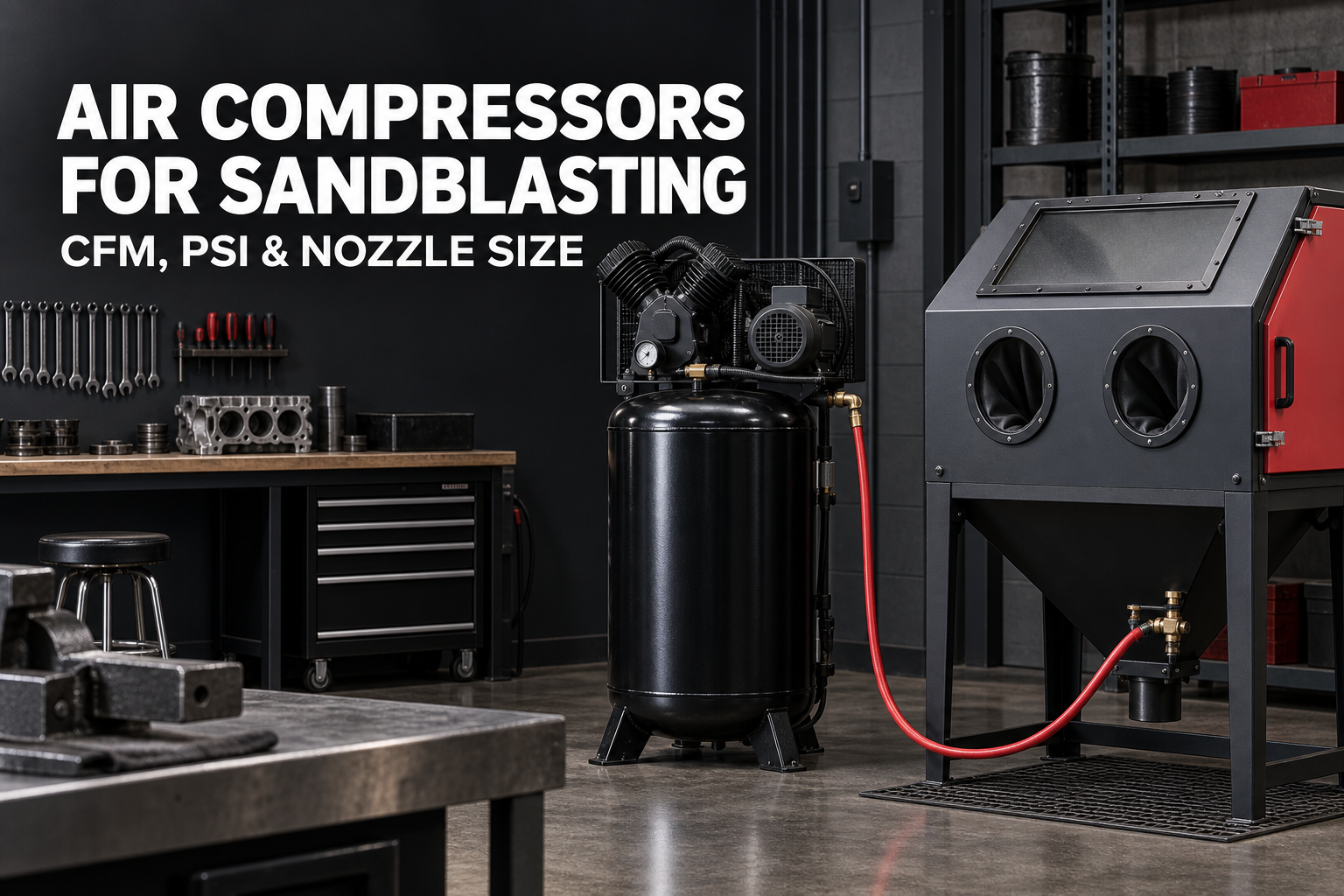
The right air compressor for sandblasting must deliver enough CFM continuously at the pressure required by the blast gun or nozzle. Receiver size and horsepower matter, but neither can make up for a compressor that falls short on sustained airflow.
If the compressor will also supply hand tools, compare their demand in our air-tool CFM chart. For a compressor that no longer builds or holds pressure normally, work through our air compressor troubleshooting guide before deciding whether capacity is the problem.
Start by identifying the blasting system. A pressure-blast pot and a siphon-feed blast cabinet use air differently and should not be sized from the same table. Then account for nozzle wear, hose restrictions, moisture treatment, other simultaneous air loads, reserve capacity, and the compressor’s duty rating.
The Short Answer: Size the Compressor by Sustained CFM
Use this order when sizing an air compressor for abrasive blasting:
- Identify whether the system is pressure fed or siphon fed.
- Find the manufacturer’s CFM requirement for the installed nozzle or air jet at the intended operating PSI.
- Add any air used at the same time, including supplied breathing air or pneumatic accessories.
- Add the reserve specified by the blast-equipment manufacturer for nozzle wear, leakage, and normal operating variation.
- Size piping, hose, fittings, filters, and dryers for the flow, then verify dynamic pressure while blasting.
- Confirm that the compressor can deliver that airflow at the required pressure for the full blasting cycle.
Compare compressors by manufacturer-rated delivered airflow or free air delivery at the required discharge pressure. Do not rely on displacement CFM, receiver gallons, or motor horsepower alone.
A large receiver can support a short surge. Abrasive blasting is usually a sustained demand, so a receiver cannot cover a continuing gap between nozzle consumption and compressor output. When demand exceeds production, receiver pressure falls until blast performance drops or the operator must stop.
Browse air compressors after calculating the required airflow and duty cycle for the complete blasting setup.
Pressure Blasters and Siphon Cabinets Use Air Differently
Pressure-blast systems
A pressure-blast machine pressurizes the abrasive vessel and meters abrasive into the compressed-air stream. These systems can clean or profile surfaces quickly, but airflow demand rises sharply as nozzle diameter increases.
For pressure blasting, size from the nozzle orifice and the desired pressure at the nozzle. The pressure shown on the compressor or pot gauge can be higher than the pressure available at the nozzle because hose, valves, couplings, dryers, and filters create pressure loss.
Siphon-feed blast cabinets
A siphon gun uses compressed air through an air jet to create the vacuum that draws abrasive into the gun. The air jet and nozzle work as a matched pair.
This distinction matters. Two siphon guns may use the same nominal nozzle but different air jets and therefore require different CFM. Clemco’s BNP data, for example, lists both its No. 4 and No. 5 gun arrangements with a 5/16-inch nozzle. The larger 5/32-inch air jet in the No. 5 arrangement raises demand from 21 to 32 CFM at 80 PSI.
When shopping cabinet blasters, use the cabinet or gun manual’s specified air-jet/nozzle combination. Do not apply a pressure-pot nozzle chart to a siphon cabinet.
Pressure-Blast Nozzle CFM by Size and PSI
The following figures are from Clemco’s compressed-air and abrasive-consumption chart. They show nozzle airflow only. They do not include breathing air, pneumatic controls, leakage, or reserve capacity.
Nozzle number | Orifice diameter | CFM at 60 PSI | CFM at 80 PSI | CFM at 100 PSI |
|---|---|---|---|---|
No. 2 | 1/8 in. | 13 | 17 | 20 |
No. 3 | 3/16 in. | 30 | 38 | 45 |
No. 4 | 1/4 in. | 54 | 68 | 81 |
No. 5 | 5/16 in. | 89 | 113 | 137 |
No. 6 | 3/8 in. | 126 | 161 | 196 |
No. 7 | 7/16 in. | 170 | 217 | 254 |
No. 8 | 1/2 in. | 224 | 280 | 338 |
Source: Clemco Industries, Compressed Air and Abrasive Consumption. Figures are reference values under the conditions used for Clemco’s chart. Confirm the exact nozzle, abrasive, pressure, and equipment specification before selecting a compressor.
The table also shows why "What PSI should I use?" is only half of the sizing question. A compressor may reach 100 PSI while the system is idle yet fail to maintain that pressure once a large nozzle begins consuming air.
Set the operating pressure according to the blast-equipment manufacturer, abrasive, substrate, coating, and required surface profile. Measure pressure as close to the nozzle as the equipment procedure allows. Never exceed the rated working pressure of the blast machine, hose, fittings, filters, dryer, or other system components.
Siphon Blast Cabinet Air Requirements
This table comes from Clemco’s BNP 65 and BNP-220 suction blast cabinet manual. In this system, the air-jet diameter and nozzle diameter are a matched combination.
BNP gun setup | Air-jet orifice | Nozzle orifice | Airflow at 80 PSI |
|---|---|---|---|
No. 4 | 1/8 in. | 5/16 in. | 21 CFM |
No. 5 | 5/32 in. | 5/16 in. | 32 CFM |
No. 6 | 3/16 in. | 3/8 in. | 47 CFM |
No. 7 | 7/32 in. | 7/16 in. | 62 CFM |
No. 8 | 1/4 in. | 1/2 in. | 86 CFM |
Source: Clemco Industries, BNP 65 and BNP-220 Suction Blast Cabinets manual. These numbers apply to the listed Clemco gun combinations at 80 PSI. They are not universal ratings for every cabinet or every nozzle with the same diameter.
Cabinet ventilation or reclaimer airflow is a separate specification. A "600 CFM reclaimer" describes the cabinet’s dust-handling airflow, not the compressed air required by the blast gun.
The exact cabinet manual remains the primary sizing source. Some compact guns and cabinets use less air than the combinations above, while larger air jets, multiple guns, blow-off nozzles, and pulse-cleaning systems can increase simultaneous demand.
How to Calculate the Compressor Capacity You Need
1. Start with the correct nozzle or air-jet demand
For a pressure pot, use the pressure-nozzle table or the equipment manufacturer’s chart. For a siphon cabinet, use the gun’s specified air-jet and nozzle combination.
Use airflow at the pressure you intend to maintain during blasting. A compressor rating at a lower PSI does not prove it will deliver the same CFM at a higher operating pressure.
2. Add every simultaneous air load
Include each device that may run while the operator is blasting:
- Blast nozzle or siphon gun
- Supplied-air respirator
- Pneumatic controls
- Air-powered dryer components
- Cabinet blow-off guns
- Dust-collector pulse cleaning
- Additional blast guns
- Other equipment on the same compressed-air system
Use each manufacturer’s stated demand. Clemco’s pressure-blast planning chart, for example, adds 20 CFM for a supplied-air helmet before applying reserve. Breathing-air requirements depend on the specific respirator and regulator, so use the respirator manufacturer’s pressure and airflow table.
The breathing-air supply must meet the applicable air-quality and respiratory-protection requirements. Do not assume the ordinary blast-air connection can be split to supply a respirator.
3. Add the manufacturer’s reserve for wear and operating variation
Clemco’s complete pressure-blast system estimate adds 50 percent reserve after combining nozzle demand with 20 CFM for the helmet. Its resulting minimums at 100 PSI are:
Pressure nozzle | New-nozzle airflow | Plus 20 CFM helmet | Clemco 50% reserve | Clemco minimum air estimate |
|---|---|---|---|---|
No. 4, 1/4 in. | 81 CFM | 101 CFM | 50 CFM | 151 CFM |
No. 5, 5/16 in. | 137 CFM | 157 CFM | 79 CFM | 236 CFM |
No. 6, 3/8 in. | 196 CFM | 216 CFM | 108 CFM | 324 CFM |
No. 7, 7/16 in. | 254 CFM | 274 CFM | 137 CFM | 411 CFM |
No. 8, 1/2 in. | 338 CFM | 358 CFM | 179 CFM | 537 CFM |
Source: Clemco Industries, Blast System Air Volume Estimates. Values reproduce the rounding in Clemco’s published chart. The helmet allowance and 50 percent reserve are Clemco’s planning method for the illustrated pressure-blast system. Use actual auxiliary-load figures and manufacturer instructions for a different installation.
Other manufacturers handle wear differently. Empire, for example, advises sizing pressure-cabinet compressors to the next-larger nozzle. Use the reserve method stated for the specific blast equipment. Do not stack unrelated rules of thumb.
For a cabinet, do not automatically copy the pressure-blast total. Start with the cabinet manufacturer’s CFM figure, add the cabinet’s actual simultaneous pneumatic loads, and provide the margin specified for leakage, wear, and normal variation.
Reserve capacity does not fix an undersized air path. Size the piping, hose, couplings, filters, and dryers for total flow and acceptable pressure loss, then verify dynamic pressure at the blast equipment.
4. Compare against delivered CFM and duty rating
Suppose a siphon cabinet uses Clemco’s No. 5 combination at 32 CFM and no other pneumatic device runs at the same time. A compressor whose manufacturer-rated delivered output is below 32 CFM at 80 PSI will lose pressure during continuous blasting. A model rated only slightly above 32 CFM may also leave too little allowance for leakage, wear, and operating variation.
The final choice must satisfy both requirements:
- Enough delivered CFM at the required pressure
- A duty rating that supports the expected blasting schedule
This is where the compressor manufacturer’s data sheet matters. The label on the receiver does not establish either capability.
Why Nozzle Wear Changes Compressor Requirements
Abrasive gradually enlarges a blast nozzle’s orifice. As the opening grows, the nozzle consumes more air. Blast performance may begin to fall even though the regulator setting and compressor have not changed.
Clemco’s nozzle-wear chart shows how increasing the orifice changes demand. At 100 PSI, a 1/4-inch opening uses 81 CFM; a 5/16-inch opening uses 137 CFM. That is about 69 percent more air. Larger openings in the chart require 196 CFM at 3/8 inch, 254 CFM at 7/16 inch, and 338 CFM at 1/2 inch.
Measure the nozzle bore with the correct gauge and replace the nozzle at the wear limit specified by its manufacturer. Do not treat the next nozzle size as permission to keep using a worn component. A worn nozzle can increase air and abrasive consumption while changing the blast pattern.
Replacement nozzles and related abrasive blasting products should be matched to the gun, holder, abrasive, and available airflow.
Hose Diameter and Pressure Drop
A compressor can be large enough on paper and still deliver poor blasting performance through an undersized or overly restrictive air path.
Select the air-supply hose, blast hose, fittings, and machine piping from the equipment manufacturer’s current compatibility and sizing instructions. Hose length and internal diameter both matter. A nominal connection size alone does not establish adequate flow through a coupling, regulator, or filter. Clemco provides compressor air-line reference charts; confirm the complete arrangement with the blast-machine manual.
Check:
- Compressor outlet and plant piping
- Air-supply hose ID and length
- Couplings and full-flow fittings
- Moisture separator, filter, regulator, and dryer flow ratings
- Blast-machine piping and valves
- Blast-hose ID
- Kinks, damaged liners, leaks, and abrupt restrictions
Measure dynamic pressure while air is flowing. Static gauge pressure can look acceptable before the trigger or deadman control opens and then collapse under load.
Do not raise compressor pressure beyond equipment ratings to mask an undersized hose or restrictive fitting. Correct the restriction and verify nozzle pressure using the equipment manufacturer’s procedure.
Moisture Control for Abrasive Blasting
Compressed air cools as it travels through the system, allowing water vapor to condense. Moisture can cause fine abrasive to clump, interrupt media flow, plug metering components, and make blast performance inconsistent.
Clemco’s BNP cabinet manual states that the inlet filter reduces condensed water and notes that an air dryer or aftercooler may be needed when filtration alone does not keep media dry and flowing.
A practical moisture-control train may include:
- An aftercooler or adequate cooling distance after the compressor
- A separator with an automatic or regularly serviced drain
- Properly sized particulate and coalescing filtration where required
- A refrigerated or desiccant dryer selected for the flow, inlet temperature, pressure, and desired dew point
- A final point-of-use separator or filter installed according to the blasting-equipment manual
Every treatment component must be rated for the required CFM. An undersized dryer or filter can create enough pressure drop to starve the nozzle.
Review air dryers and filters by rated airflow, pressure drop, drain arrangement, and service requirements. A small disposable dryer may suit an intermittent low-flow gun but should not be assumed to handle a high-CFM pressure blaster.
Duty Cycle, Receiver Size and Compressor Type
Abrasive blasting can hold the air valve open for minutes at a time. That makes duty cycle a central selection factor.
Check the compressor manufacturer’s stated duty rating and operating limits. If a reciprocating compressor is not approved for continuous operation, plan blast and recovery periods that keep it within those limits. Sustained production commonly points toward equipment designed for a high or continuous duty cycle, but the correct choice depends on airflow, pressure, environment, service access, and workload.
Receiver capacity still has useful roles. It can:
- Reduce rapid cycling
- Buffer short changes in demand
- Help stabilize system pressure
- Provide time for condensate to separate as air cools
It cannot provide continuous CFM after the stored air is depleted. If the compressor produces 25 CFM while the blast gun consumes 40 CFM, the system has a continuing 15 CFM deficit regardless of tank size.
For a shared shop system, calculate the realistic simultaneous demand. A blast cabinet, pressure blaster, blow-off station, and other air consumers cannot each be sized as if they operate alone when they may run together.
Abrasive-Blasting Safety
Abrasive blasting exposes workers to high-velocity particles, dust, noise, pressurized equipment, and hazards released from the surface being cleaned. Compressor sizing should never be separated from the controls needed to operate the system safely.
Abrasive media and substrate hazards
Read the current safety data sheet for the abrasive and assess the substrate and coating before work begins. Dust may contain hazardous material from the abrasive, the underlying surface, or the coating being removed.
NIOSH recommends that silica sand not be used as abrasive media. Substituting a different abrasive does not eliminate every silica risk because concrete, masonry, some coatings, and other blasted materials may contain crystalline silica. Old coatings may also introduce lead, chromates, or other toxic contaminants.
Use appropriate containment, local exhaust ventilation, dust collection, work practices, protective clothing, gloves, hearing protection, and eye and face protection. Follow the blast-equipment and abrasive manufacturers’ instructions.
Respiratory protection and silica exposure
OSHA 29 CFR 1910.94 identifies specific abrasive-blasting situations that require abrasive-blasting respirators. When respiratory protection is required, employers must use NIOSH-approved respirators appropriate to the hazard and implement a respiratory-protection program under 29 CFR 1910.134. Supplied breathing air must also meet the applicable air-quality and use requirements.
NIOSH identifies Type CE supplied-air abrasive-blasting respirators as suitable for abrasive-blasting operations. Different approved configurations provide different levels of protection; a continuous-flow hood is not adequate for every exposure. Respirator selection still requires a hazard assessment, exposure evaluation, correct assigned protection factor, medical evaluation, fit testing where applicable, training, inspection, and maintenance under the employer’s compliant program.
Air-purifying respirators should not be treated as the default protection for the person operating an open abrasive-blast nozzle. Workers performing auxiliary tasks also need protection selected for their measured or reasonably anticipated exposures.
For general-industry workplaces, OSHA’s respirable crystalline silica requirements are in 29 CFR 1910.1053. Construction work is covered by 29 CFR 1926.1153. Determine which standard applies, evaluate exposure from both the abrasive and the blasted material, and involve a qualified safety or industrial-hygiene professional when hazards or exposure levels are uncertain.
Pressurized equipment and hose safety
Before service, isolate the compressed-air supply, lock out and tag out the energy source as required, and bleed stored pressure according to the equipment manual.
Use rated hose, couplings, safety pins, and hose restraints. Inspect the blast hose and air line for soft spots, cuts, coupling damage, or other wear. Never point a blast nozzle at a person. Use the required deadman control and do not defeat interlocks on a blast cabinet.
Compressor Sizing Checklist
Before purchasing or connecting a compressor, confirm each item:
- Pressure-blast or siphon-feed system identified
- Exact nozzle or air-jet/nozzle combination identified
- Manufacturer CFM at the intended operating PSI documented
- Delivered compressor CFM checked at that pressure
- Nozzle-wear reserve included using the blast-equipment manufacturer’s method
- Supplied-air respirator and auxiliary loads included
- Simultaneous shop demand included
- Compressor duty rating suitable for the work cycle
- Air line, valves, fittings, and blast hose sized for the flow
- Dryer, filters, and separator rated for the total CFM
- Dynamic pressure checked while blasting
- Equipment pressure ratings not exceeded
- Abrasive and substrate hazards assessed
- Ventilation, containment, respiratory protection, and PPE addressed
Frequently Asked Questions
What size air compressor do I need for sandblasting?
Match the compressor’s manufacturer-rated delivered CFM at pressure to the exact blast nozzle or siphon gun. A 1/4-inch pressure nozzle in Clemco’s chart consumes 81 CFM at 100 PSI before other loads and reserve. A Clemco No. 5 BNP siphon gun consumes 32 CFM at 80 PSI. The correct number depends on system design, nozzle or air jet, pressure, wear, and simultaneous demand.
How many CFM does a blast cabinet need?
Use the cabinet or blast-gun manual. In Clemco’s BNP siphon-gun table, single-gun demand ranges from 21 CFM to 86 CFM at 80 PSI as the matched air jet and nozzle become larger. Compact cabinets can have different requirements. Do not confuse dust-collector or reclaimer CFM with compressor CFM.
Is 90 or 100 PSI enough for sandblasting?
Those pressures fall within the operating range of many abrasive-blasting systems, but there is no universal setting. Required PSI depends on the equipment, abrasive, substrate, coating, and desired result. Confirm the manufacturer’s range and measure pressure under airflow near the nozzle. Never exceed the lowest-rated component.
Does a larger compressor tank improve sandblasting?
A larger receiver can buffer short peaks and reduce cycling, but it does not increase the compressor’s sustained airflow. If nozzle demand remains higher than compressor output, pressure will continue to fall once stored air is used.
Can a worn nozzle require more CFM?
Yes. Abrasive wear enlarges the orifice, which increases airflow demand. Clemco’s nozzle-wear chart shows 81 CFM for a 1/4-inch opening and 137 CFM for a 5/16-inch opening at 100 PSI. Inspect and gauge the nozzle according to the manufacturer’s instructions.
Is a rotary screw compressor required for sandblasting?
Not in every case. The compressor must provide the necessary delivered CFM and pressure while operating within its rated duty cycle. A properly rated reciprocating compressor may support an intermittent small cabinet. Longer or production blasting may require equipment designed for sustained service. Use the compressor manufacturer’s duty and installation data.
Can I use silica sand as blast media?
NIOSH recommends that silica sand not be used as abrasive media because abrasive blasting can create dangerous respirable crystalline silica exposure. Alternative media can have their own hazards, and the blasted surface may also release silica or toxic coating dust. Review safety data sheets and complete a task-specific hazard assessment.
Match the Complete Blasting System
Successful abrasive blasting depends on the complete air path, not one compressor number. Match the compressor, air treatment, piping, hose, blast machine, gun or nozzle, abrasive, dust controls, and protective equipment as one system.
National Tool Warehouse carries sandblasting equipment, air compressors, cabinet blasters, air dryers and filters, and abrasive blasting products. Check each product’s current specifications and manufacturer documentation before finalizing a combination.
Technical Sources and Caveats
- Clemco Industries, Compressed Air and Abrasive Consumption
- Clemco Industries, Blast System Air Volume Estimates
- Clemco Industries, BNP 65 and BNP-220 Suction Blast Cabinets manual
- Clemco Industries, Effects of Nozzle Wear on Air Consumption
- OSHA, Ventilation and Abrasive Blasting, 29 CFR 1910.94
- OSHA, Respirable Crystalline Silica for General Industry, 29 CFR 1910.1053
- OSHA, Respirable Crystalline Silica for Construction, 29 CFR 1926.1153
- NIOSH, Silicosis in Sandblasters: A Case Study
- NIOSH, Type CE Abrasive-Blast Supplied-Air Respirator Notice
Figures apply to the cited configurations. Actual demand and pressure loss vary by wear, abrasive, altitude, hose, fittings, temperature, leakage, and system design. Follow the equipment, compressor, air-treatment, and respirator manuals.