
Tool Chest vs. Roller Cabinet: Which Should You Choose?
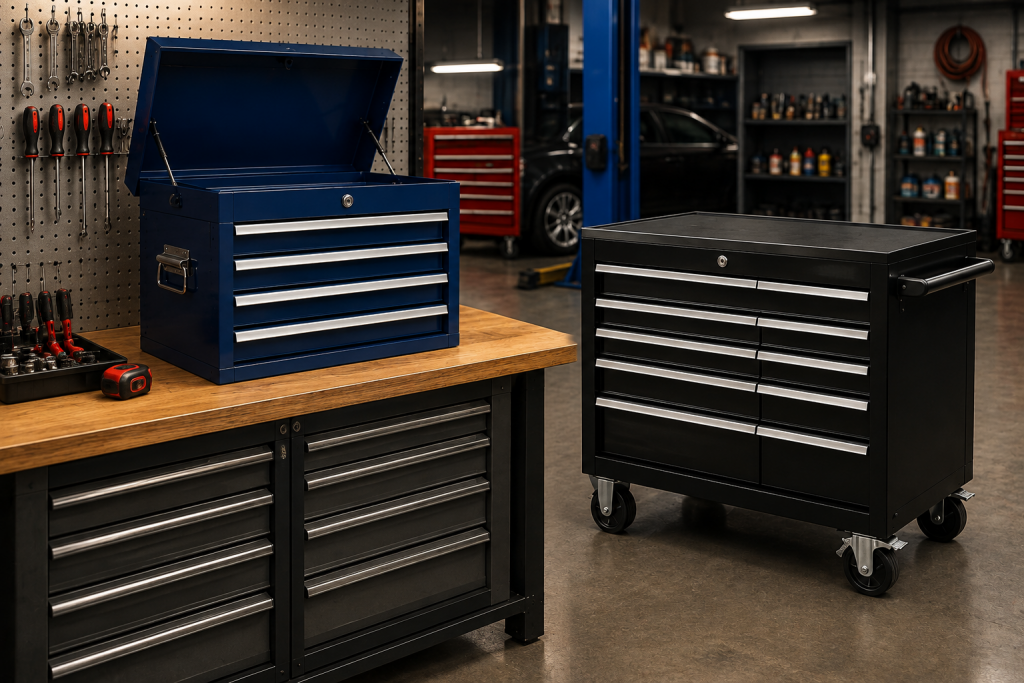
A tool chest is an upper or benchtop drawer unit that organizes smaller hand tools without using additional floor space. A roller cabinet is a floor-standing drawer unit on casters that usually offers more room for heavy tools, mobility around the shop, and a usable top surface. Choose a chest when you already have a sturdy bench or cabinet base. Choose a roller cabinet when you need a complete, mobile storage foundation. Many growing tool collections benefit from using both as a matched stack.
For portable boxes and expandable storage beyond a chest-and-cabinet stack, compare modular tool storage systems. Use our garage hand-tools list to inventory what the drawers need to hold.
The names are not always used consistently. Some people call an entire stacked setup a tool chest, while manufacturers may use terms such as top chest, top box, roller cabinet, rolling cabinet, roll cab, rollaway, or bottom box. For this comparison, tool chest means the upper unit without casters, and roller cabinet means the wheeled base unit.
Tool Chest vs. Roller Cabinet at a Glance
| Factor | Tool chest | Roller cabinet |
|---|---|---|
| Placement | On a workbench, sturdy table, or compatible cabinet | On the floor |
| Mobility | Usually stationary once loaded | Rolls within a garage or shop on casters |
| Drawer layout | Often favors shallow drawers for hand tools | Commonly mixes shallow and deeper drawers |
| Work surface | Uses bench space or occupies the top of a cabinet | May provide a work surface when the top stays clear |
| Floor footprint | Adds vertical storage without a new footprint when stacked | Requires dedicated floor space and drawer clearance |
| Expansion | Can add capacity above a compatible base | Can support a compatible top chest and some side storage |
| Best fit | Smaller collections, benchtop access, vertical expansion | Growing collections, heavy tools, mobile shop storage |
| Main tradeoff | Needs a safe support surface and can reduce worktop space | Heavier, larger, and less portable than its wheels suggest |
What Is a Tool Chest?
A tool chest, often called a top chest or top box, is a multi-drawer unit designed to sit on a workbench or a compatible roller cabinet. Many models have a hinged lid above the top drawers. The format is especially useful for sockets, ratchets, wrenches, pliers, screwdrivers, measuring tools, and other hand tools that fit well in shallow drawers.
The main advantage is vertical organization. If your bench or rolling cabinet can safely support the chest, you can add drawers without claiming more floor area. The tradeoff is that the chest needs a stable base. Once it is loaded, moving or lifting it may be impractical. A tall stack can also place upper drawers or the lid beyond a comfortable reach.
A tool chest can work well on its own when:
- You already have a sturdy workbench with enough depth.
- Most of your collection consists of hand tools and small parts.
- You want tools visible at roughly bench height.
- Floor space is limited but vertical space is available.
- You plan to add a compatible roller cabinet later.
What Is a Roller Cabinet?
A roller cabinet is a floor-standing storage unit with drawers, casters, and a handle or other provision for moving it within a work area. It is also called a rolling cabinet, roll cab, rollaway, or bottom box. Compared with a top chest, it often includes a broader mix of drawer depths for hand tools, power tools, cases, and heavier equipment.
The cabinet is usually the foundation of a larger storage system. Its top may serve as a temporary work surface, hold frequently used tools, or support a matching chest. Locking casters help keep the unit in place during use, while a cabinet lock helps control access to the drawers.
Wheels do not make a loaded roller cabinet portable in the same sense as a hand-carry box or modular jobsite system. A cabinet may roll easily on smooth concrete yet be difficult to control across cracks, thresholds, cords, slopes, or uneven flooring. It is built for mobility within a shop, not routine loading into a vehicle.
A roller cabinet is usually the better starting point when:
- You need storage for both small and bulky tools.
- You want the option to move your main tool collection around a garage or service bay.
- You do not have a suitable bench for a top chest.
- You want a stable base that can accept future storage additions.
- You value an open top that can double as a work or staging surface.
When a Tool Chest Is the Better Choice
Choose a tool chest when your main problem is organizing smaller tools at a fixed work area. A chest puts many shallow drawers within reach and uses space above a bench or cabinet rather than adding another unit to the floor.
This setup is a strong fit for a home mechanic with an established workbench, a machinist organizing precision tools, or anyone expanding a compatible roller cabinet. It can also be a practical first purchase for a modest collection if the support surface is stable, deep enough, and rated for the loaded chest.
Before buying, account for what the chest will displace. A chest placed on a workbench reduces available work area. A chest added to a roller cabinet can remove the cabinet’s flat top as a work surface. Check the height of the finished setup too. You should be able to open the lid fully and reach the upper drawers without stretching or using an unsafe step.
When a Roller Cabinet Is the Better Choice
Choose a roller cabinet when you need a complete storage base, more varied drawer depths, or shop-floor mobility. It is usually the more versatile first purchase for a growing tool collection because it does not depend on an existing bench and can accept a compatible chest later.
A cabinet also makes sense for heavier tools. Deep lower drawers can keep power tools, large sockets, pullers, and cases closer to the floor, which can help the unit remain stable. Frequently used hand tools can stay in the upper drawers for faster access.
The worktop is another deciding factor. If you often need a flat surface beside a vehicle or project, keeping the cabinet top open may be more useful than stacking a chest on it. A wide roller cabinet can provide lower, easier-to-reach storage and more work area, while a narrow stacked system favors vertical capacity.
Should You Buy a Tool Chest and Roller Cabinet Combo?
A matched chest-and-cabinet combination gives you the shallow organization of a top chest and the deeper capacity of a rolling base. It is a sensible long-term setup when your collection is large, still growing, or split between precision hand tools and bulkier equipment.
The safest approach is to treat compatibility as a specification, not an assumption. Check the manufacturer’s listed width and depth, the cabinet’s top load limit, the chest footprint, attachment or retention provisions, and any model-family requirements. Similar outside dimensions do not prove that two units from different brands or product lines are designed to stack together.
Also consider the finished height and center of gravity. Keep the heaviest tools in the lower cabinet, lock casters before opening drawers, and follow the manufacturer’s stacking and anti-tip instructions. Avoid opening several heavily loaded drawers at the same time.
If you are building the system in stages, the roller cabinet is usually the more flexible first purchase. It works as a standalone storage unit and may preserve a work surface while your collection is smaller. Add the matched top chest when you need more shallow-drawer capacity. A chest-first purchase makes more sense when you already have a suitable bench and your immediate need is compact hand-tool organization.
What to Compare Before You Buy
Start With Your Actual Tool Inventory
List the tools you own now and the ones you are likely to add. Group them by size and weight. Sockets, wrenches, pliers, and measuring tools often suit shallow drawers. Power tools, cases, and larger specialty tools need deeper, wider drawers.
Drawer count alone can be misleading. Check the usable inside dimensions of the drawers and compare them with your longest and tallest tools. A cabinet with fewer well-sized drawers may fit your collection better than one with many shallow drawers that force bulky tools elsewhere.
Measure the Space and the Access Route
Measure the available width, depth, and height, then include room for fully opened drawers, handles, the raised chest lid, and your body as you work. Check the route into the garage or shop as well, including doors, steps, tight corners, and thresholds. Large cabinets may arrive by truck freight and may require assembly or help to position safely.
In a small garage, confirm that open drawers will not interfere with a parked vehicle, door swing, or workbench aisle. For an under-bench cabinet, include the caster and worktop height rather than relying on the cabinet body dimension alone.
Check Drawer Slides and Capacity Ratings
Ball-bearing and full-extension slides can improve access to loaded drawers, but the rating matters. Review the capacity for each drawer, the total cabinet capacity, and the caster rating. These numbers describe different parts of the system and should not be treated as interchangeable.
Use current manufacturer specifications for the exact model. Do not assume that every drawer in a cabinet carries the same rating, especially when some drawers use reinforced or double slides.
Evaluate Casters for Your Floor
Look at caster diameter, material, total rating, swivel configuration, and brake design. Then match those features to the real floor. Smooth, level concrete is easier than expansion joints, broken surfaces, thresholds, or sloped driveways.
Plan to move the cabinet slowly and only with drawers closed and secured. For regular transport between locations, a portable box or modular tool storage system is usually more appropriate than a shop roller cabinet.
Compare Construction, Security, and Organization
Useful details include cabinet construction, drawer reinforcement, slide quality, corrosion-resistant finish, drawer retention, locks, liners, dividers, and replacement-part support. Steel gauge can help compare models, but it is not a complete measure of durability. Weld quality, frame design, drawer construction, and hardware also affect how a cabinet performs.
Decide what security means in your setting. A keyed lock can discourage casual access, but a roller cabinet is not a safe. In a shared shop, consider how keys are controlled and whether individual drawers stay retained when the unit moves.
Plan for Expansion Without Buying Empty Space Blindly
A little room for growth can prevent an early replacement, but oversized storage can consume valuable shop space and budget. Look for a system that supports the additions you are likely to use, such as a matching top chest, side cabinet, drawer organizers, or service cart.
Verify that those additions are still available for the exact product family. “Expandable” is useful only when the parts fit, the base can support them, and the finished setup remains comfortable to use.
Best Setup by Workspace and Workflow
Small Home Garage or DIY Bench
A compact tool chest works well when you have a strong bench, a mostly hand-tool collection, and limited floor space. Choose a small roller cabinet instead if bench space is more valuable than floor space or if you need deeper drawers. Measure vehicle clearance before committing to either setup.
Growing Automotive Tool Collection
Start with a roller cabinet that has a useful mix of shallow and deep drawers. It can hold the current collection, keep heavier items low, and provide a base for a compatible top chest later. Add drawer organizers before assuming you need a larger cabinet, since better layout may recover substantial usable space.
Professional Service Bay
A roller cabinet keeps a broad tool set together and can move within a bay. Prioritize drawer and caster ratings, brakes, locks, drawer retention, serviceability, and a layout that keeps frequent tools near waist height. A matched top chest adds capacity, but a clear worktop may be more valuable for daily workflow.
Tools That Move Between Jobs
Neither a traditional top chest nor a full roller cabinet is ideal for frequent vehicle transport. A service cart can keep a smaller active set mobile inside a shop, while portable or modular storage is better suited to tools that regularly travel between sites. Keep the main cabinet as the organized home base.
Find the Right Tool Storage at National Tool Warehouse
The best choice depends on the tools, the workspace, and how the storage will be used after it is loaded. A top chest is an efficient way to add organized vertical storage. A roller cabinet is the stronger standalone foundation for varied tools and shop-floor mobility. A matched combination gives a growing collection both kinds of capacity.
Explore tool storage, tool boxes, and shop cabinets at National Tool Warehouse, or browse roller bearing tool boxes and rolling storage. Compare the current dimensions, capacities, shipping details, and manufacturer compatibility notes on each product page before choosing a setup.
Frequently Asked Questions
Is a roller cabinet the same as a tool chest?
Not in the strict product sense. A roller cabinet is a floor-standing drawer unit on casters. A tool chest or top chest is an upper unit designed for a workbench or compatible cabinet. In everyday conversation, people sometimes use “tool chest” for the full stacked combination.
Can you use a tool chest without a roller cabinet?
Yes, if it sits on a stable workbench or other support that is deep enough and rated for the chest’s loaded weight. Check lid clearance, reach height, and the amount of work surface the chest will occupy.
Can any tool chest sit on any roller cabinet?
No. Match the manufacturer’s compatibility guidance, outside and footprint dimensions, cabinet top capacity, and attachment or retention features. Do not assume that similar widths or different-brand units are safe to stack.
Which stores more tools, a chest or a roller cabinet?
Roller cabinets generally provide more varied storage and deeper drawers, while top chests often concentrate on shallow drawers for hand tools. Actual capacity depends on the model’s usable drawer dimensions and ratings, so compare specifications rather than the product name alone.
Is a roller cabinet easy to move when it is loaded?
It can be easy to reposition on a smooth, level shop floor when the casters are properly rated. Cracks, thresholds, slopes, debris, and soft surfaces can make movement difficult or unsafe. Close and secure the drawers before moving the cabinet.
Is a tool chest and roller cabinet combo worth it?
A combo is useful when you need both shallow hand-tool organization and deeper storage for bulky tools. It is less attractive when the added chest makes the setup too tall or removes a work surface you use every day. A matched system also requires more budget and careful compatibility checks.
Can a roller cabinet be used as a workbench?
Some roller cabinets have a top designed as a work or staging surface, but the allowed use and load vary. Follow the product specifications, protect the surface as recommended, lock the casters, and avoid tasks that could make the cabinet unstable.