
Modular Tool Storage Systems: How to Choose the Right Setup
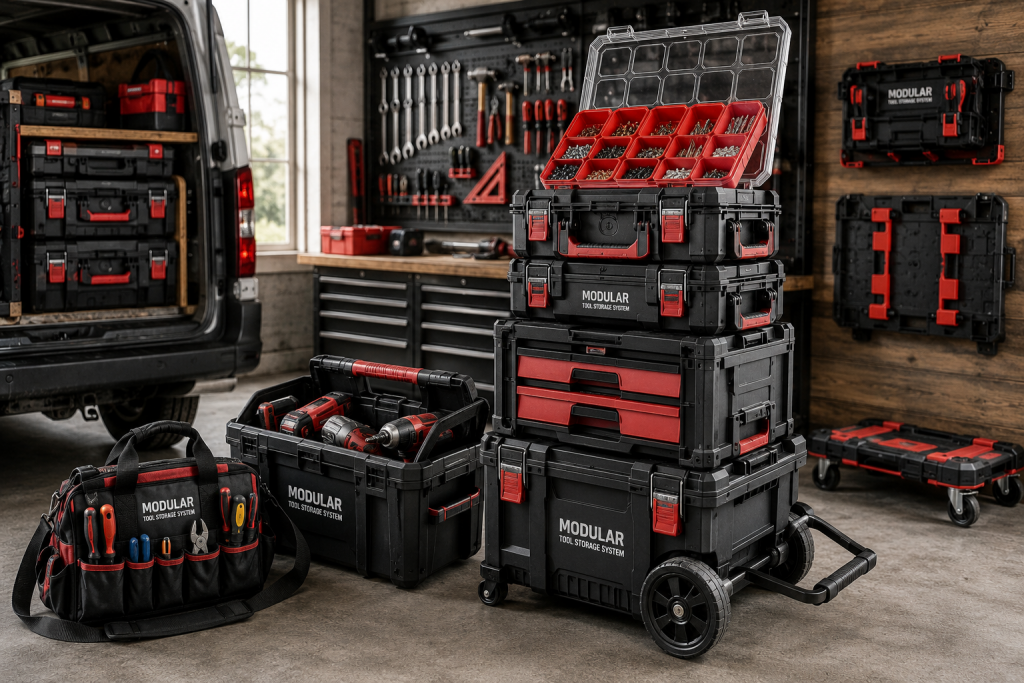
Modular tool storage systems combine compatible boxes, drawers, organizers, bags, rolling bases, and mounting accessories into one expandable platform. The right system can make tools easier to organize, protect, move, and access, but the best choice depends on how and where you work.
If your tools mainly stay in one workshop, compare a tool chest with a roller cabinet before choosing portable modules.
Start with your workflow before you compare brand names. Think about the tools you carry, how often you need them, the surfaces you cross, where the system will ride in your vehicle, and which components you may want later. Those details matter more than choosing the largest or most popular stack.
What Is a Modular Tool Storage System?
A modular tool storage system is a group of storage components designed to connect through a shared latch or mounting platform. A typical system may include:
- A rolling tool box or dolly
- Deep boxes for power tools and bulky equipment
- Drawer units for hand tools and frequently used accessories
- Clear-lid organizers for fasteners, fittings, and small parts
- Open crates, totes, bags, or backpacks
- Worktops, wall plates, racks, and vehicle mounts
Unlike a single tool box, a modular system can be rearranged for different jobs. You might take a rolling base, one drawer box, and an organizer to a service call, then leave less-used modules on a garage wall or shop rack.
Most systems use a proprietary connection design. Components from one brand usually do not lock directly to another brand’s platform, even when the boxes look similar. That makes the first purchase more than a box choice. It is often a decision about the ecosystem you will use for future drawers, organizers, mounts, and accessories.
Why Choose Modular Tool Storage?
Modular storage works well when a tool collection has outgrown a bag or when tools need to move between a garage, service bay, vehicle, and jobsite.
Build capacity over time
You can begin with a few useful components and add more as your tool collection or work changes. That can be easier than trying to predict the perfect cabinet or chest size at the beginning.
Create task-based loadouts
Separate modules can keep related tools together. An electrical setup might include meters, hand tools, connectors, and labels. An automotive setup might group sockets, diagnostic tools, and common service items. For a broader inventory check, National Tool Warehouse’s guide to essential hand tools can help you identify what needs a dedicated place.
Improve access and organization
Drawers, bins, and dividers can make it easier to see what is available without emptying a deep box. Transparent organizer lids also make it easier to check small-parts stock before leaving for a job.
Connect mobile and stationary storage
Some ecosystems offer wall plates, shop racks, dollies, and vehicle mounting options. This allows the same modules to work as mobile storage during the day and organized shop storage afterward.
How to Choose the Right Modular Tool Storage System
Use the following criteria to narrow the field. A system that performs well in one setting may be inconvenient in another.
Start with how and where you work
List the environments where the storage will be used most often.
- Fixed garage or service bay: Prioritize drawers, visibility, a compact footprint, and easy movement across smooth floors. A traditional cabinet or one of National Tool Warehouse’s tool carts may still be better when the tools rarely leave the shop.
- Service van or pickup: Look for manageable module sizes, secure latches, vehicle clearance, and manufacturer-approved mounting or tie-down options.
- Rough jobsite: Consider wheel diameter, ground clearance, handle strength, stack stability, and the ability to separate the load for stairs or truck-bed loading.
- Small-parts-heavy work: Prioritize clear lids, removable bins, shallow drawers, dividers, and labels.
- Mixed shop and mobile use: Check whether the ecosystem offers both rolling and wall-mounted components so tools do not need to be repacked.
Decide how you need to access tools
Top-opening boxes usually provide generous open capacity for drills, saws, chargers, and bulky equipment. Their main drawback appears when the needed box is in the middle or at the bottom of a stack.
Drawer modules provide access without unstacking. They are useful for hand tools, batteries, bits, sockets, and frequently used supplies. The trade-offs are added weight, higher cost, and less open interior volume.
Many users benefit from a mixed setup: one deep box for bulky tools, one drawer unit for daily-access items, and one organizer for parts. For example, a PACKOUT 2-drawer tool box illustrates how a drawer module can sit within a larger connected platform. Check current specifications and availability before choosing any exact component.
Check wheels, handles, and vehicle fit
A box can be durable and still be awkward to transport. Evaluate the complete loaded stack, not just the empty base.
Ask these questions:
- Are the wheels suited to smooth concrete, gravel, mud, or stairs?
- Does the handle provide enough leverage when the stack is loaded?
- Can the handle collapse or detach for a pickup bed, trunk, or tonneau cover?
- Can one person safely load the base into the vehicle?
- Will tall stacks remain stable when turning or crossing uneven ground?
- Can modules be removed quickly when the full stack is too heavy?
Horizontal rolling systems can be easier to access and may fit under some truck-bed covers, but they use more floor space. Vertical stacks use a smaller footprint, but their height can complicate loading and access.
Compare durability and environmental protection
Look beyond broad terms such as rugged or weather-resistant. Compare the features that affect your actual environment:
- Impact-resistant body construction
- Reinforced corners and handles
- Latch material and ease of replacement
- Drawer retention during transport
- Lid gaskets and published dust or water ratings
- Locking points
- Wheel and axle construction
Do not assume every component in an ecosystem has the same weather protection. A brand may publish an ingress rating for certain closed boxes while drawers, crates, bags, or accessories have different levels of protection. Verify the current manufacturer specification for the exact item you plan to use.
Evaluate the whole ecosystem
The best base is less useful if the platform lacks the components you need later. Review the current selection of:
- Deep and compact boxes
- Two-, three-, or multi-drawer units
- Small-parts organizers
- Crates, bags, and totes
- Dollies and rolling bases
- Wall and vehicle mounts
- Worktops and trade-specific accessories
- Replacement dividers, bins, wheels, and latches
Also consider whether the range appears to be actively supported in the USA. A newer ecosystem may offer thoughtful features but fewer modules. A mature ecosystem may provide more choices, accessories, and third-party support, but the size of the range can make selection more complicated.
Understand compatibility and lock-in
Most modular platforms are designed to keep users inside one ecosystem. Similar dimensions do not guarantee compatible latches or safe stacking.
Adapters exist for some combinations, but fit, load limits, warranty implications, and transport safety vary. Use manufacturer-approved adapters when available and verify the exact model numbers. Do not rely on an adapter for vehicle transport unless its maker specifically supports that use.
Price the complete setup and consider loaded weight
Compare the cost of a useful configuration, not a single promotional box. Include the rolling base, drawers, organizer, dividers, mounts, and specialty accessories you realistically expect to buy.
Then estimate the loaded weight of each module. A box’s rated capacity is not the same as a comfortable lifting weight. Splitting tools into smaller modules can make loading easier, but too many small pieces may slow down setup and increase cost.
Popular Modular Tool Storage Approaches at a Glance
The systems below appear frequently in current US comparisons. This is not a universal ranking. Product ranges, specifications, and availability change, so verify the components that matter to your setup.
| System | Typical best fit | Access or mobility angle | What to verify before buying |
| Milwaukee PACKOUT | Buyers who want a broad range of compatible storage and mounting options | Vertical mobile stacks, drawers, organizers, and stationary mounting options | Exact module availability, total loaded weight, and cost of the planned setup |
| DeWalt ToughSystem 2.0 | Heavy-duty mobile and workshop use | Rolling boxes, drawers, and workshop-oriented components | ToughSystem 2.0 versus TSTAK compatibility and the exact accessories required |
| FLEX Stack Pack | Users who prioritize connection and drawer access | Mobile stacks with drawer and external accessory options | Current USA module range and long-term expansion choices |
| RIDGID Pro Gear 2.0 | Value-focused buyers who need core boxes and drawers | Practical rolling and drawer configurations | Current organizers, carts, mounts, and replacement support |
| Makita MAKTRAK | Pickup-oriented users who prefer a lower layout | Horizontal transport and access | Vehicle footprint, loading method, and current ecosystem size |
| Klein MODbox | Electricians and field technicians using pouches and hard cases | Trade-focused external and soft-storage integration | The exact trade accessories and drawer options available |
| Ryobi LINK | Garage and lighter-duty mixed storage | Portable boxes plus wall-storage options | Duty level, capacity, and component fit for the intended work |
| ToughBuilt StackTech | Buyers interested in feature-focused boxes and accessories | Drawers, organizers, and external attachments | Current USA availability, replacement support, and planned modules |
Milwaukee PACKOUT
PACKOUT is often considered when ecosystem breadth is the priority. The platform includes boxes, drawers, organizers, soft storage, dollies, work surfaces, mounting plates, and specialty accessories. It can suit users who want many configuration options and expect to expand over time. The large range also makes it important to plan the first stack carefully so you do not buy accessories that add weight without improving your workflow.
DeWalt ToughSystem 2.0
ToughSystem 2.0 is positioned for heavy-duty mobile storage and includes rolling boxes, drawers, organizers, and workshop-oriented components. Buyers should distinguish ToughSystem 2.0 from DeWalt TSTAK because the names refer to different platforms with different connection considerations. National Tool Warehouse’s additional tool storage options can help you review current storage formats carried across brands.
FLEX Stack Pack
Stack Pack is frequently noted for user-friendly connection and access features, including drawer configurations and external accessory options. It may appeal to users who value quick engagement and daily access. Compare the available module range with your long-term plan before committing.
RIDGID Pro Gear 2.0
Pro Gear 2.0 is commonly considered by buyers seeking a balance of durable construction and value. The practical question is whether its current drawer, organizer, cart, and accessory selection covers the way you intend to work.
Makita MAKTRAK
MAKTRAK uses a lower, more horizontal approach than traditional vertical towers. That design can improve access and pickup-oriented transport for some users. The wider footprint and the size of the current ecosystem should be part of the decision.
Klein MODbox
MODbox places strong emphasis on trade-focused accessories and the combination of hard cases with pouches or soft storage. Electricians, HVAC technicians, and maintenance professionals may find that approach useful when consumables and hand tools need to remain close at hand.
Ryobi LINK
LINK combines portable boxes with wall-storage options and is often considered for garages, workshops, and lighter-duty mobile use. Compare construction, capacity, and available modules with the demands of your work rather than assuming every system targets the same duty level.
ToughBuilt StackTech
StackTech is a feature-focused platform with boxes, drawers, organizers, and external attachment options. As with any newer or changing ecosystem, confirm current USA availability, replacement support, and the modules you need before building a large setup.
How to Build a Practical Starter Stack
A useful starter setup usually needs only three to five components. Starting small gives you time to learn what should stay mobile, what needs drawer access, and what belongs on a wall or cart.
1. Choose the base
Use a rolling tool box for rougher transport, a dolly or rolling drawer base for smooth shop floors, or a stationary rack or plate for a shop-first setup. The base should support the terrain and the weight you expect to carry.
2. Add daily-access storage
Choose drawers for tools you reach for repeatedly. Use a deep lidded box for bulky equipment that does not need constant access. Keep the heaviest practical module low in the stack, while following the manufacturer’s stacking and load instructions.
3. Add a small-parts organizer
Use removable bins or divided organizers for fasteners, fuses, fittings, connectors, drill bits, and other consumables. A clear lid helps with quick inventory checks.
4. Add dividers, trays, or foam where they solve a real problem
Dividers can separate tools inside drawers, while foam can protect meters, electronics, or calibrated equipment during transport. Components such as PACKOUT drawer dividers show how an existing drawer can be adapted to a specific layout without adding another box.
5. Test the loaded stack before expanding
Roll it across the surfaces you actually use. Load it into the vehicle. Open every drawer and lid. Carry individual modules up stairs. Check whether the handle, stack height, and access pattern remain comfortable after the tools are inside.
Example Setups by Workflow
Mobile contractor or remodeler
Start with an all-terrain rolling base, a deep box for cordless tools, a drawer unit for hand tools and batteries, and a clear-lid organizer for fasteners. Build separate task modules for electrical work, finish work, or punch-list jobs instead of carrying every tool every day.
Automotive garage or service bay
Use a low rolling drawer base or dolly, two or three shallow drawers for sockets and hand tools, and a small-parts organizer for clips, fuses, and service items. If the tools stay in one bay, compare this setup with a full tool cart or cabinet before investing in a mobile ecosystem.
Home garage and DIY projects
Begin with a compact rolling box, one organizer, and either a tote or drawer module. Add wall storage only after you know which tools stay in the garage and which ones travel around the house, yard, or vehicle.
Common Buying Mistakes
Choosing by brand color alone
Your cordless-tool brand does not have to determine your storage platform. Most boxes can hold tools from any manufacturer. Choose the storage features that fit your work.
Ignoring access to lower boxes
A tall stack of top-opening boxes may look efficient until the most-used tool is at the bottom. Plan the order around access frequency and consider drawers for daily-use items.
Building too much too soon
Large starter bundles can include pieces you rarely use. Begin with a base, one daily-access module, and one organizer. Expand after several weeks of real work.
Overlooking loaded weight
The full stack may roll well and still be difficult to lift into a pickup or move on stairs. Test the load in individual modules and keep a plan for breaking the stack down.
Assuming different brands connect
Treat cross-brand compatibility as unverified until the exact modules and adapter have been confirmed. A secure shop connection may not be appropriate for transport.
Forgetting future availability
Before investing heavily, check whether the ecosystem offers replacement parts and the drawer, organizer, wall, or vehicle components you expect to add later.
Keep the System Organized
Modularity does not replace a good organization routine. Use these habits to keep the system useful:
- Label drawers and organizers by task or contents.
- Use consistent bin sizes where possible.
- Keep frequently used tools in drawers or top modules.
- Place heavier modules low and lighter modules high.
- Remove duplicate tools and empty packaging regularly.
- Restock consumables after each job.
- Secure modules and rolling bases during vehicle transport.
- Clean latches, seals, slides, and wheels so they continue to operate properly.
Are Modular Tool Storage Systems Worth It?
Modular tool storage systems are often worth considering for people who move tools regularly, want to organize by task, or need storage that can grow from a few boxes into a coordinated shop and vehicle setup. Their main advantages are flexibility, access choices, and expansion.
They are not automatically the best option for every collection. A small set of tools may fit a bag or portable box. A large collection that never leaves a garage may be easier to use in a fixed cabinet or rolling cart. Modular systems also create platform lock-in, and the cost can grow as drawers, organizers, mounts, and accessories are added.
The practical approach is to choose around your workflow, start with a small configuration, and expand only when a new component solves a clear storage or access problem. Browse National Tool Warehouse’s tool storage solutions to compare boxes, carts, organizers, and accessories that fit the way you work.
Frequently Asked Questions
Are modular tool storage systems compatible across brands?
Usually not. Most brands use proprietary latches, rails, or footprints. Some adapters may connect specific components, but their load limits and approved uses vary. Confirm exact model compatibility and use manufacturer-approved solutions, especially for vehicle transport or heavy stacks.
Are drawers better than top-opening tool boxes?
Drawers are better when you need frequent access without unstacking. Top-opening boxes generally provide more open space for bulky tools and may cost or weigh less. Many effective setups use drawers for daily-access items and one deep box for larger equipment.
Are modular tool boxes waterproof?
Do not assume they are waterproof. Some closed boxes have published dust and water protection ratings, while drawers, crates, bags, and other components may differ. Check the current rating for the exact product and follow the manufacturer’s limits.
What should I buy first for a modular setup?
Start with a base that fits your terrain, one module for frequently used tools, and one organizer for small parts. Add a deep box, tote, wall mount, or specialty accessory only after the starter setup has been used in real work.
Which modular system is best for a garage?
The best garage setup depends on whether the tools also need to travel. A shop-only collection may work better in drawers, a cart, or a cabinet. For mixed use, look for compact rolling options, wall mounts, clear organizers, and drawer modules that keep frequently used tools visible.
How should I organize tools in a modular system?
Group tools by task and access frequency. Keep heavy items low, daily-use tools in drawers or top modules, bulky equipment in deep boxes, and fasteners in labeled organizers. Review the setup regularly and remove components that add weight without serving a clear purpose.