
Socket Drive Size Guide: How to Choose the Right Drive
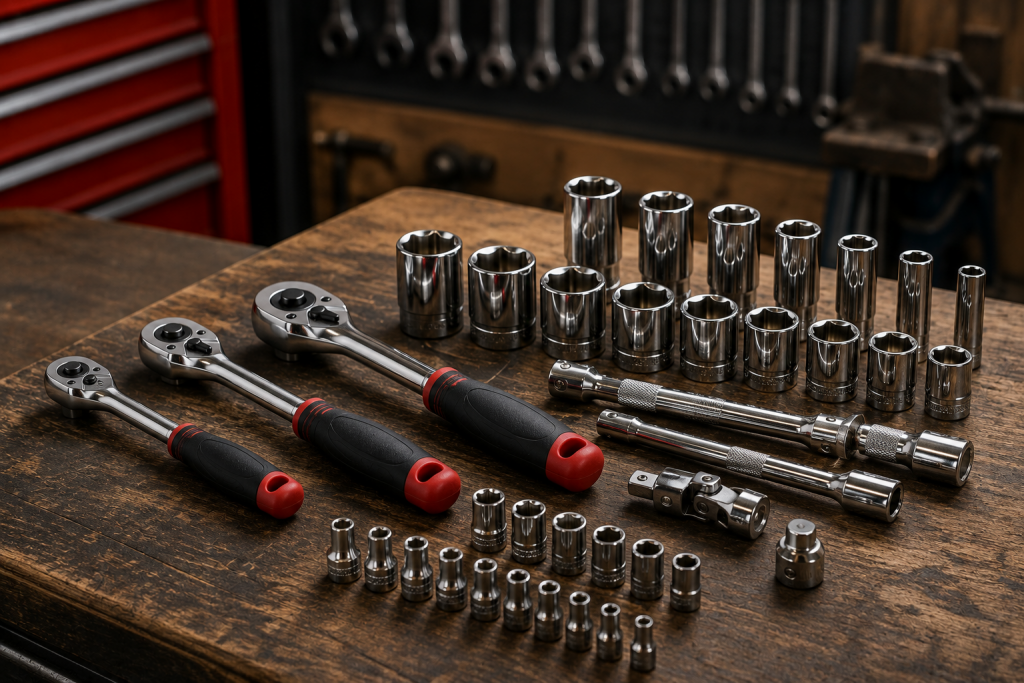
The right socket drive size depends on the fastener, available space, required leverage, and tool being used. A 1/4-inch drive is compact and well suited to smaller fasteners. A 3/8-inch drive is the versatile choice for a broad range of automotive and maintenance work. A 1/2-inch drive provides a larger, stronger connection for many wheel, suspension, and other higher-load jobs. Larger 3/4-inch and 1-inch drives are generally reserved for heavy equipment, trucks, industrial maintenance, and similarly demanding applications.
Drive size also needs to match the tool doing the work. Compare air impact wrench applications and learn how a torque wrench controls final tightening before choosing a socket setup.
Drive size is only one part of the choice. You also need the correct socket opening, depth, point count, measurement system, and construction for the job.
Quick Answer: Which Socket Drive Size Do You Need?
Use this as a starting point:
- Choose 1/4-inch drive for compact access, smaller fasteners, interior work, electronics enclosures, small engines, and light assembly.
- Choose 3/8-inch drive for general automotive repair, maintenance, engine-bay work, and a versatile everyday set.
- Choose 1/2-inch drive for many larger automotive fasteners, wheels, brake and suspension work, and applications that require a more substantial ratchet or impact wrench.
- Choose 3/4-inch or 1-inch drive for heavy trucks, farm and construction equipment, industrial machinery, and other jobs that call for tools specifically rated for large fasteners and high loads.
These are application guidelines, not universal torque limits. The capacity of a setup depends on every component, including the ratchet, socket, extension, adapter, power tool, and fastener. Check the manufacturers’ ratings and the relevant service procedure.
What Does Socket Drive Size Mean?
Socket drive size is the size of the square connection between a socket and the tool that turns it. A 3/8-inch drive socket fits directly onto a 3/8-inch ratchet, breaker bar, torque wrench, or compatible power tool.
The common drive sizes are 1/4 inch, 3/8 inch, 1/2 inch, 3/4 inch, and 1 inch. The drive must match on both sides of the connection unless an appropriate adapter is used.
Drive Size Is Different From Socket Opening Size
The square drive is on the back of the socket. The opening that fits the nut or bolt head is on the working end. They describe two different dimensions.
For example, a 10 mm socket may be available with a 1/4-inch or 3/8-inch drive. Both fit a 10 mm fastener, but they connect to different ratchets. Likewise, a 1/2-inch drive set may include many metric or SAE socket opening sizes.
This distinction matters when replacing a missing socket or assembling a tool set. First identify the fastener opening you need, then select a suitable drive size for the access, load, and tool.
Socket Drive Size Comparison
| Drive size | General use | Main advantage | Main limitation |
|---|---|---|---|
| 1/4 inch | Small fasteners and confined spaces | Compact head and lighter tool | Less suited to large or stubborn fasteners |
| 3/8 inch | General automotive and maintenance work | Strong balance of access and capability | May be too bulky for very tight areas or too small for heavy work |
| 1/2 inch | Larger automotive and higher-load work | More substantial tools and greater leverage | Heavier and harder to position in confined spaces |
| 3/4 inch | Heavy equipment and industrial work | Built for larger tools and sockets | Size, weight, and cost |
| 1 inch | Heavy truck and demanding industrial service | Supports specialized heavy-duty tooling | Excessive for most passenger vehicle and household jobs |
National Tool Warehouse carries sockets, ratchets, and drive tools across these categories, so buyers can compare the complete setup rather than choosing a socket in isolation.
What Is a 1/4-Inch Drive Used For?
A 1/4-inch drive is useful when access and control matter more than maximum leverage. The smaller ratchet head and slimmer overall setup can reach fasteners that leave little room for a larger tool.
Common uses include:
- Interior trim and dashboard work
- Small engine components
- Hose clamps and small brackets
- Battery terminals
- Electronics and appliance enclosures
- Light assembly and maintenance
The compact handle can also make it easier to avoid applying excessive force to a small fastener. It is still important to use the specified tightening procedure, especially with small threaded parts that are easy to damage.
A 1/4-inch socket set is a practical addition when an existing set is too bulky for close quarters.
What Is a 3/8-Inch Drive Used For?
For many buyers, 3/8-inch drive offers the best balance of reach, handling, socket coverage, and everyday usefulness. It fits a broad range of automotive and general maintenance tasks without the bulk of a 1/2-inch setup.
Typical uses include:
- Engine-bay repairs
- Accessory and bracket removal
- Spark plug service with the correct spark plug socket
- Brake component work where the procedure and tool rating permit
- General equipment and household maintenance
- Moderate-size nuts and bolts
A 3/8-inch ratchet often reaches areas where a 1/2-inch ratchet feels cumbersome, while providing a more substantial setup than many 1/4-inch tools. That versatility makes a 3/8-inch socket set a sensible starting point for a general-purpose toolbox.
What Is a 1/2-Inch Drive Used For?
A 1/2-inch drive is commonly selected for larger fasteners and work that benefits from a longer handle, stronger square drive, or compatibility with a 1/2-inch impact wrench.
Applications often include:
- Passenger vehicle lug nuts
- Suspension and chassis work
- Larger brake and hub components
- Heavy brackets and mounts
- Farm, shop, and equipment maintenance
Do not choose a 1/2-inch drive based only on the socket opening size. Consider the service procedure, access, fastener condition, and ratings of the complete tool stack. Use the specified torque value and a suitable torque wrench for final tightening when the procedure calls for one.
Browse 1/2-inch socket sets when larger automotive work is a regular part of the job.
When Do You Need a 3/4-Inch or 1-Inch Drive?
A 3/4-inch or 1-inch drive is generally specialized equipment. These larger systems are common in heavy truck service, agricultural equipment, construction machinery, fleet operations, and industrial maintenance.
The larger drive does not automatically make it correct for every stubborn fastener. It requires compatible sockets, extensions, handles, torque equipment, and power tools. The weight and size may also make the setup impractical on passenger vehicles or in confined areas.
Buyers working on genuinely heavy applications can compare 3/4-inch impact sockets and 1-inch impact sockets by application and manufacturer specification.
How to Choose a Socket Drive Size for the Job
Use this five-part check before reaching for a ratchet:
- Identify the fastener. Determine the exact metric or SAE opening and the fastener style.
- Check access. Look at the room around and above the fastener. A smaller drive, shallow socket, flex-head ratchet, or extension may improve access.
- Consider the load. A larger or seized fastener may call for a more substantial drive system, but every component must be rated for the work.
- Match the operating tool. Hand ratchets, torque wrenches, breaker bars, impact wrenches, and powered ratchets have different use cases.
- Follow the service information. Use the equipment or vehicle manufacturer’s sequence, torque specification, and replacement guidance.
If one toolbox must cover light through heavier automotive tasks, a combination of 1/4, 3/8, and 1/2-inch tools is more useful than forcing one drive size into every job.
Other Socket Choices That Matter
Metric vs. SAE
Metric sockets are marked in millimeters. SAE sockets use fractional inches. Use the exact system and size specified for the fastener.
Some metric and SAE openings appear close, but a near match can fit poorly and increase the risk of rounding the fastener. Clean dirt or corrosion from the head, seat the socket fully, and move to the correct size if the fit is loose.
Shallow vs. Deep
Shallow sockets keep the tool compact and are useful where overhead clearance is limited. Deep sockets can reach nuts on exposed studs and recessed fasteners.
Depth is an access decision, not a strength ranking. Check the product specifications and choose the shortest socket that fully engages the fastener while clearing the stud or surrounding components.
6-Point vs. 12-Point
A 6-point socket contacts the flats of a standard hex fastener and is a strong default for stubborn or higher-load work. A 12-point socket offers twice as many engagement positions, which can help where ratchet movement is limited. It is also required for certain 12-point fasteners.
Use the fastener style specified by the application. A 12-point socket is not a substitute for specialty profiles such as Torx, external Torx, spline, hex bit, or triple-square.
Hand Sockets vs. Impact Sockets
Use impact-rated sockets and accessories with an impact wrench. Impact sockets are designed for the repeated shock loads produced by powered impact tools. Chrome hand sockets should not be used as substitutes.
Hand sockets are often slimmer, which can improve access with a manual ratchet. Impact sockets may have thicker walls and require more clearance. Inspect either type before use and remove damaged components from service.
National Tool Warehouse offers impact socket sets for buyers matching sockets to powered equipment.
Can You Use Socket Drive Adapters?
A drive adapter can connect components with different square-drive sizes, such as a 3/8-inch ratchet to a 1/4-inch drive socket. Adapters are helpful for occasional access problems, but they do not turn a smaller component into a higher-capacity tool.
The smallest or lowest-rated component may limit the setup. An adapter also adds length and another connection point, which can affect access and control. Use impact-rated adapters with impact tools, observe the manufacturer’s ratings, and avoid stacking multiple adapters when a direct-fit socket is available.
For repeated work, buy the socket in the drive size that matches the tool. Browse extensions and adapters when a compatible accessory is genuinely the right solution.
Socket and Ratchet Safety Tips
- Wear suitable eye protection and follow workplace safety requirements.
- Confirm that the socket fits the fastener and seats fully.
- Match the socket, extension, adapter, and accessory to the operating tool.
- Use impact-rated components with impact wrenches.
- Inspect sockets for cracks, deformation, excessive wear, or damaged drive openings.
- Check ratchets, breaker bars, torque wrenches, and power tools for proper operation.
- Keep hands clear of pinch points and maintain stable footing.
- Do not exceed manufacturer ratings or modify handles for extra leverage.
- Follow the vehicle or equipment service procedure for tightening sequence and torque.
- Use a suitable torque wrench for final tightening when a torque specification is provided.
A larger drive cannot correct a damaged fastener, poorly seated socket, or unsuitable working angle. Stop and reassess if the socket slips, twists, or fails to engage cleanly.
Building a Useful Socket Set
A practical general automotive collection often starts with:
- A compact 1/4-inch metric and SAE set
- A broad 3/8-inch set with shallow and deep sockets
- A 1/2-inch set for larger fasteners
- 6-point sockets for common hex fasteners
- Selected extensions and universal or flex accessories
- Impact sockets in the sizes used with an impact wrench
- A torque wrench appropriate to the specified applications
A master socket set can provide coordinated drive sizes and storage. Before buying, compare the included size range, shallow and deep coverage, point style, ratchet design, and replacement availability. A high piece count is less useful if the set omits the sizes used most often.
Frequently Asked Questions
What is the most common socket drive size?
The 3/8-inch drive is a common general-purpose choice because it covers many automotive and maintenance tasks while remaining reasonably compact. Professional and well-equipped home toolboxes usually include multiple drive sizes.
Does drive size determine what fastener a socket fits?
No. Drive size describes the square connection to the ratchet or power tool. The socket opening size determines which nut or bolt head it fits.
Should I buy a 3/8-inch or 1/2-inch drive first?
Choose 3/8 inch for broad general use and better access. Choose 1/2 inch first if the planned work centers on wheels, suspension, larger equipment, or a compatible impact wrench. Many automotive users eventually need both.
What drive size is commonly used for lug nuts?
A 1/2-inch drive is common for passenger vehicle lug nuts, but the socket opening, tool capacity, and torque specification must match the vehicle. Use an impact-rated socket with an impact wrench, then follow the vehicle manufacturer’s final tightening procedure.
Can impact sockets be used with a hand ratchet?
An impact socket can generally be used manually when it fits the drive and fastener and the manufacturer permits the application. Its thicker wall may prevent access in tight spaces, so a hand socket may still be more practical.
Can I use a drive adapter with an impact wrench?
Only use an adapter specifically rated for impact use and within its manufacturer’s limits. The adapter and smaller drive component can limit the setup. A direct-fit impact socket is preferable for frequent or demanding work.