
How Does a Torque Wrench Work?
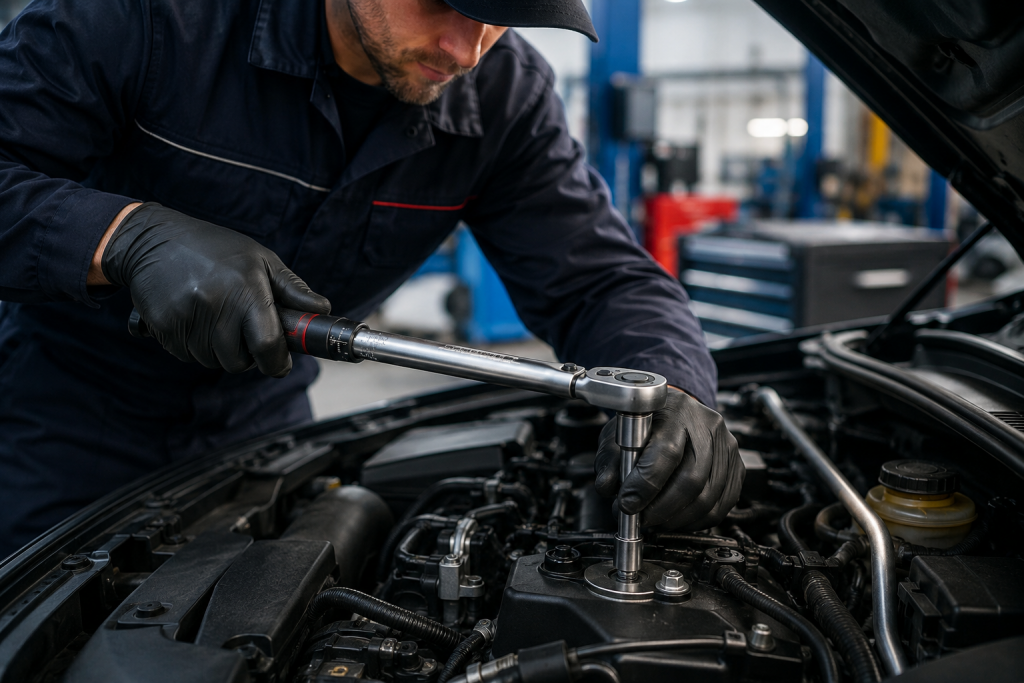
A torque wrench works by measuring or controlling the twisting force applied to a fastener. The user sets or monitors a specified torque value, and the wrench provides a physical or electronic signal when that value is reached. Depending on the design, that signal may be a click, pointer movement, dial reading, beep, light, or vibration.
Pair the wrench with a compatible drive and socket using our socket drive size guide. For the different role of powered fastener removal, see what an air impact wrench does.
This allows a nut or bolt to be tightened more accurately than it would be by feel alone. Too little torque may leave a connection loose, while excessive torque may damage threads, stretch a bolt, distort a component, or create an incorrect clamping load.
A torque wrench is therefore best understood as a precision measuring tool rather than simply a stronger ratchet.
What Is Torque?
Torque is the rotational or twisting force applied around a pivot point.
In simple terms:
Torque = force × distance from the pivot point
Imagine tightening a bolt with a wrench. If you push close to the wrench head, you create less torque. If you apply the same amount of force at the end of a longer handle, you create more torque because the force is acting farther from the pivot point.
The angle at which the force is applied also matters. A force applied perpendicular to the handle produces the greatest turning effect. Pulling at an angle reduces the amount of force that contributes to rotation.
Torque is commonly measured in:
- Foot-pounds or pound-feet: ft-lb
- Inch-pounds: in-lb
- Newton-meters: Nm
Always use the torque value and unit specified by the vehicle, equipment, fastener, or component manufacturer. A value stated in inch-pounds should not be entered as foot-pounds, and vice versa.
What Does a Torque Wrench Do?
A torque wrench helps tighten a fastener to a predetermined or measurable torque value.
It is different from other common hand tools:
- A standard ratchet turns a fastener but does not measure torque.
- A breaker bar provides extra leverage for loosening or tightening stubborn fasteners.
- A torque wrench measures applied torque or signals when a selected value has been reached.
The tool does not automatically know how tight a particular bolt should be. The technician must first obtain the correct specification and then set or monitor the wrench accordingly.
Torque specifications may be found in a vehicle service manual, equipment manual, technical data sheet, or manufacturer instructions.
How Does a Click-Type Torque Wrench Work?
A click-type torque wrench is one of the most familiar designs used in automotive repair, workshops, and general maintenance.
Most adjustable click wrenches use a spring-loaded internal mechanism. The user sets the wrench to a required torque value by adjusting the handle or another control.
The process generally works as follows:
- The user unlocks the handle.
- The handle is rotated to the required torque setting.
- Adjusting the handle changes the tension on an internal spring.
- The wrench is locked at the selected value.
- A socket is fitted to the drive.
- The user applies smooth, steady force to the handle.
- Resistance inside the wrench increases as the fastener tightens.
- When the preset torque is reached, the internal mechanism momentarily releases or pivots.
- That movement creates a click that can usually be heard and felt.
- The user stops applying force immediately after the first clear click.
The click is the tool’s way of telling the user that the selected torque value has been reached.
Certain micrometer-style models allow the user to rotate the handle to choose a torque setting and provide both a physical and audible indication when the target value is reached.
Why Does a Torque Wrench Click?
A torque wrench clicks because its internal release mechanism reacts when the selected torque value is reached.
The click is a signal, not an automatic shutoff.
A click-type wrench may still continue turning if the user keeps pulling after the click. This means that the fastener can still be overtightened even though the wrench has already signaled.
Stop after the first clear click. Repeatedly clicking the wrench can continue increasing the load on the fastener.
Does a Click Mean the Bolt Is Fully Tightened?
The click means that the selected torque has been reached under the current conditions. It does not independently confirm that every aspect of the joint is correct.
The final result can still be influenced by:
- Bolt condition
- Thread damage
- Dirt or corrosion
- Lubrication
- Washers or coatings
- Incorrect fastener specifications
- Improper tightening sequence
- Component alignment
A torque wrench controls applied torque, but correct assembly also depends on following the manufacturer’s complete procedure.
How Different Types of Torque Wrenches Work
Torque wrenches use different mechanisms and feedback systems. The correct type depends on the application, required accuracy, available space, torque range, and user preference.
Beam Torque Wrench
A beam torque wrench uses a flexible main beam and a pointer positioned over a scale.
As force is applied:
- The main beam bends slightly.
- The pointer remains aligned with the scale.
- The user watches the reading increase.
- Force is stopped when the pointer reaches the required torque value.
Beam wrenches provide a live torque reading and use a relatively simple mechanism. However, the scale must remain visible during use, which can be difficult in confined spaces.
Dial Torque Wrench
A dial torque wrench transfers internal movement to a dial indicator.
As torque is applied, a needle moves across the dial to show the current torque. Some models also capture or display a peak reading.
Dial wrenches are useful when a clear visual measurement is required. They may also be used for testing or inspection, depending on the model and application.
Split-Beam Torque Wrench
A split-beam torque wrench uses separate structural beams rather than operating in exactly the same way as a conventional micrometer spring wrench.
The user selects a target value, applies force, and receives a mechanical signal when the setting is reached.
Split-beam models are often valued for convenient adjustment and straightforward operation. Storage and resetting requirements vary, so users should follow the manufacturer’s instructions for the specific tool.
Digital Torque Wrench
A digital torque wrench uses electronic sensors to measure strain, movement, or deflection as force is applied.
The tool converts that measurement into a torque reading displayed on a digital screen.
Depending on the model, it may provide:
- A live torque reading
- Beeps
- Warning lights
- Handle vibration
- Peak torque tracking
- Unit conversion
- Stored readings
- Torque-angle measurement
Digital torque wrenches provide continuous feedback, while a mechanical click wrench generally provides a signal only when its preset target is reached.
Preset Torque Wrench
A preset torque wrench is configured to one specific torque value.
When that value is reached, the tool signals, releases, or slips depending on its design. Preset models are useful for repetitive assembly tasks where the same specification is used repeatedly.
They reduce the need to adjust the setting between fasteners, but they are less flexible than adjustable models.
How to Use a Torque Wrench Correctly
Correct technique is important because even a high-quality torque wrench can produce poor results when used incorrectly.
- Find the correct torque specification.
Use reliable manufacturer information rather than guessing. - Select the correct wrench.
Make sure the required value falls within the wrench’s rated operating range. - Check the unit.
Confirm whether the specification is stated in ft-lb, in-lb, Nm, or another unit. - Inspect the fastener and threads.
Look for dirt, damage, corrosion, cross-threading, or other problems. - Install the fastener by hand.
This helps prevent cross-threading. - Tighten it most of the way with a suitable hand tool when appropriate.
The torque wrench should normally be used for the final controlled tightening stage. - Set the torque wrench carefully.
Follow the scale, display, or adjustment instructions provided with the tool. - Attach the correct socket.
Ensure it fits the fastener properly and is fully seated on the drive. - Hold the designated handle area.
Hand position can influence the effective lever length. - Apply slow, smooth force.
Avoid sudden jerking or bouncing movements. - Stop at the first clear signal.
On a click wrench, stop after the first click. On a digital wrench, stop when the target alert appears. - Follow the correct tightening sequence.
Components such as cylinder heads, wheels, covers, and flanges may require a specific pattern and several tightening stages. - Reset and store the wrench properly.
Follow the manufacturer’s storage instructions after use.
Lubrication, thread condition, fastener coatings, washers, and tightening procedures can affect the relationship between applied torque and clamping force. Always follow the complete manufacturer procedure, not just the torque number.
Common Torque Wrench Mistakes
Continuing After the First Click
A click wrench does not lock the fastener in place or prevent further movement. Continuing to pull after the first click can add more torque.
Repeated clicks may overtighten the fastener.
Using It as a Breaker Bar
A torque wrench should generally not be the first tool used to loosen seized, corroded, or heavily tightened fasteners.
Use a breaker bar or suitable ratchet for loosening. Reserve the torque wrench primarily for controlled final tightening unless the manufacturer specifically states otherwise.
Using the Wrong Torque Range
Choose a wrench whose rated range includes the required specification.
Do not assume that one wrench is suitable for every job. A low-torque engine fastener may require a different wrench from a wheel lug nut or heavy-equipment bolt.
Pulling Too Quickly
A fast or jerking movement can make it difficult to feel the click or stop at the correct moment.
Apply force gradually and smoothly.
Holding the Wrench in the Wrong Place
The user should normally grip the wrench at the intended handle position.
Holding it too close to the head, adding an improvised handle extension, or changing the effective length can affect the applied torque.
Confusing Inch-Pounds and Foot-Pounds
Remember:
12 inch-pounds = 1 foot-pound
A specification of 120 in-lb is equal to 10 ft-lb, not 120 ft-lb.
Always check the unit before tightening a low-torque fastener.
Using an Incorrect Extension
A standard socket extension positioned along the drive axis generally does not change the effective length of the torque wrench.
An offset crowfoot, adapter, or extension that changes the distance between the drive center and the fastener may affect the resulting torque. The effect depends on its length and orientation.
Follow the torque wrench or adapter manufacturer’s calculation guidance when using offset accessories.
What Happens If a Bolt Is Over-Torqued or Under-Torqued?
The purpose of a torque specification is to create an appropriate clamping load between the assembled components. The goal is not simply to make the bolt as tight as possible.
Under-Torquing May Cause
- Insufficient clamping force
- Movement between components
- Fluid, air, or exhaust leaks
- Uneven loading
- Fasteners working loose
- Component vibration
- Premature joint failure
Over-Torquing May Cause
- Damaged threads
- Stretched fasteners
- Broken bolts or studs
- Distorted components
- Cracked housings
- Incorrect clamping force
- Damaged gaskets
- Difficulty during future removal
Some fasteners are designed to stretch in a controlled way, while others must be replaced after use. Always follow the relevant service procedure.
Do Torque Wrenches Need Calibration?
Torque wrenches are measuring instruments, and their accuracy can change over time.
Possible causes include:
- Frequent use
- Internal wear
- Being dropped
- Heavy impact
- Improper storage
- Excessive loading
- Using the wrench beyond its rated range
- Harsh workshop conditions
- Battery or electronic issues on digital models
Follow the tool manufacturer’s recommended inspection and calibration interval.
A wrench should also be checked after a significant drop, suspected overload, unexpected reading, or any event that may have affected its mechanism.
There is no single calibration interval that applies to every wrench. The correct schedule depends on the tool, frequency of use, working conditions, accuracy requirements, and manufacturer guidance.
How to Store and Maintain a Torque Wrench
Good storage and handling help protect the wrench’s accuracy and extend its useful life.
- Keep it clean and dry.
- Wipe away grease and debris after use.
- Do not submerge it in cleaning fluid.
- Protect it from drops and impacts.
- Store it in its case when one is provided.
- Do not use it as a hammer or pry bar.
- Follow the manufacturer’s instructions for spring tension.
- Remove batteries before very long storage when appropriate.
- Do not lubricate the internal mechanism unless instructed by the manufacturer.
- Have the tool inspected if it behaves differently from normal.
Many manufacturers recommend returning an adjustable click wrench to its lowest marked setting after use. Do not force the handle below its minimum setting.
What Size Torque Wrench Do You Need?
Choose a torque wrench according to the required torque range first. Drive size and available working space are also important.
1/4-Inch Drive
Commonly used for:
- Small fasteners
- Interior components
- Motorcycles
- Bicycles
- Low-torque engine work
- Inch-pound specifications
3/8-Inch Drive
Commonly used for:
- General automotive repairs
- Engine components
- Spark plugs
- Brake work
- Medium-range torque specifications
1/2-Inch Drive
Commonly used for:
- Wheel lug nuts
- Suspension work
- Larger automotive fasteners
- Higher torque values
- Light-truck repairs
3/4-Inch Drive and Larger
Commonly used for:
- Heavy trucks
- Agricultural equipment
- Industrial maintenance
- Construction machinery
- Large high-torque fasteners
Do not select a wrench based only on socket size. Confirm that its torque range suits the actual specification.
When you are ready to find the right tool, browse a selection of high-quality torque wrenches to find the perfect fit for your projects.
Click vs. Beam vs. Digital Torque Wrench
| Type | How It Signals Torque | Main Advantage | Main Consideration |
| Click | Audible and physical click | Familiar and easy to use | The user must stop after the click |
| Beam | Pointer moves across a scale | Simple mechanism with a live reading | The scale must remain visible |
| Dial | Needle displays applied torque | Clear measured reading | Can be bulkier and must be read carefully |
| Digital | Screen, beep, light, or vibration | Live readings and extra functions | Requires batteries or charging |
| Preset | Fixed-value signal or release | Consistent for repetitive work | Limited to one selected setting |
The best choice depends on the torque range, working environment, budget, required features, and frequency of use.
A click wrench is familiar and practical for many workshop jobs. A beam or dial wrench provides a visible live reading. A digital model may be preferred when unit conversion, stored readings, torque-angle measurement, or multiple warning signals are useful.
Frequently Asked Questions
How does a torque wrench know when to click?
A preset internal mechanism reacts when the applied torque reaches the selected value. This causes a small release or movement inside the wrench that creates the click.
Does a torque wrench stop automatically?
Most click-type torque wrenches do not stop automatically. The click tells the user to stop pulling.
Can you use a torque wrench to loosen bolts?
It is generally better to use a breaker bar or standard ratchet for loosening fasteners, especially stubborn ones. Use the torque wrench primarily for controlled tightening unless the manufacturer specifically allows another use.
Should you click a torque wrench twice?
No. Stop after the first clear click. Clicking the wrench repeatedly can continue increasing the load on the fastener.
Can a torque wrench be used like a regular ratchet?
It can turn fasteners, but it is a precision measuring tool and should not replace a general-purpose ratchet for routine loosening and assembly.
Does handle length affect torque?
Yes. Torque depends on the applied force and the distance from the pivot point. This is why the wrench should be held at the designated handle position.
What is the difference between ft-lb and Nm?
Foot-pounds and Newton-meters are different units used to measure torque. Set the wrench to the unit specified by the manufacturer or use an accurate conversion.
What happens if the torque wrench does not click?
Stop applying force and check:
- The selected setting
- The wrench’s rated range
- The direction of operation
- Whether the fastener is still turning
- Whether the wrench is correctly locked
- The tool’s condition and calibration
Do not continue applying excessive force while waiting for a click.
Choose the Right Torque Wrench for the Job
Accurate tightening begins with the correct torque specification, drive size, operating range, and feedback system.
Explore torque wrenches from National Tool Warehouse for automotive, workshop, industrial, and heavy-duty fastening applications.