
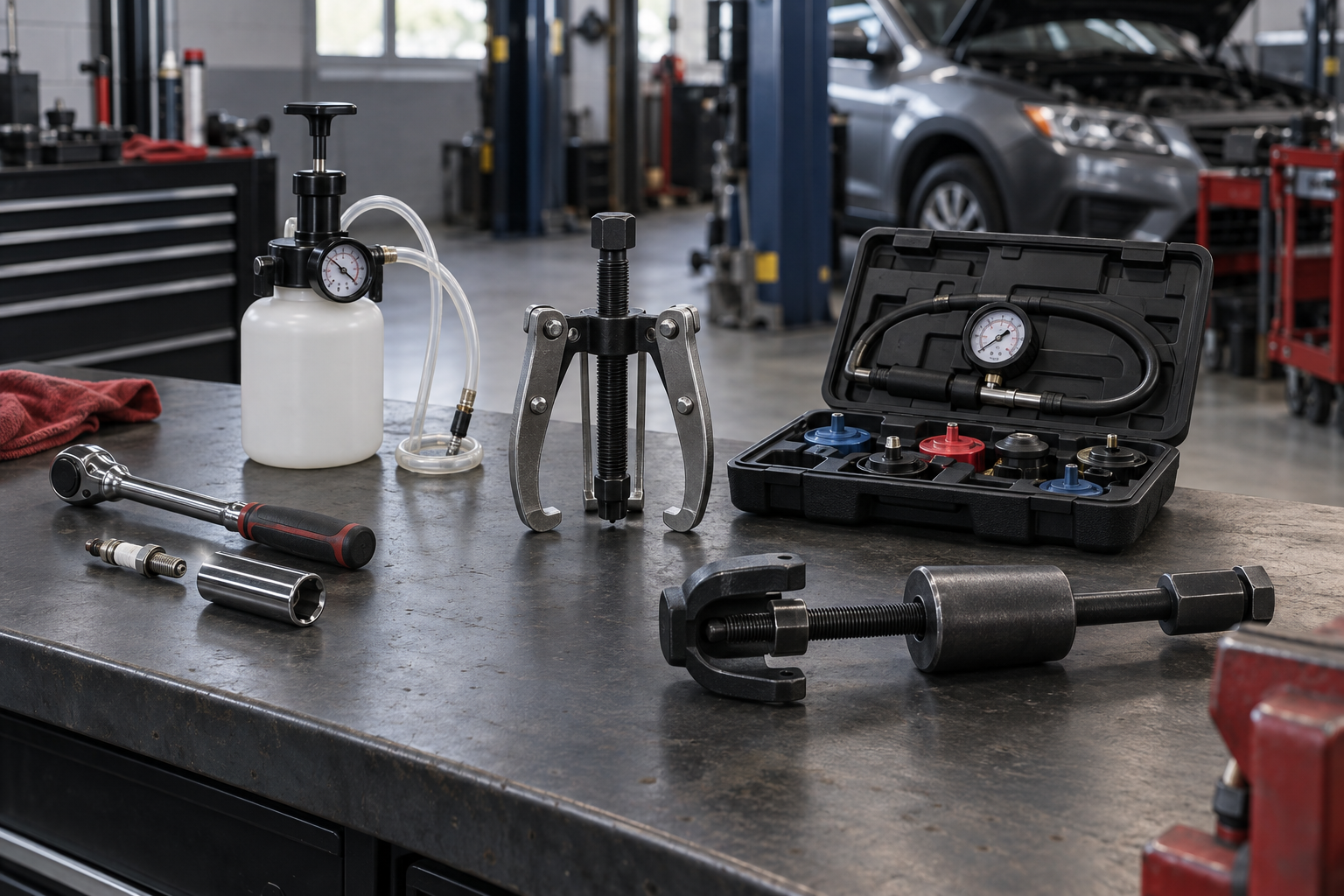
A general socket or wrench can handle many repairs. A specialty tool is chosen for a particular service task, access point or component interface. The useful starting question is therefore what job are you doing? Use this index to find the right tool family, then check the exact product and the vehicle or equipment service procedure before ordering. A category name does not establish fitment for every item in its grid.
Start with the system you are servicing
| Repair job | Tool family to browse | What to verify on the individual listing |
|---|---|---|
| Spark-plug removal and installation | Spark plug sockets | Plug hex size, reach, drive size and engine access. The category also has specialized broken-plug tools; they are not interchangeable with ordinary sockets. |
| Harmonic-balancer or damper service | Harmonic balancer pullers | Whether the task calls for removal, installation or holding; required adapters and vehicle application. |
| Brake hydraulic service | Brake bleeding tools | Pressure, vacuum or other method; adapter and fluid-system compatibility; included components. |
| Cooling-system diagnosis and hose work | Radiator tools | Whether the item is a pressure tester, hose tool or accessory; cap/adapter fit and kit contents. |
| Clutch or flywheel work | Clutch and flywheel tools | Alignment, holding, removal or installation function, and the exact drivetrain application. |
| Axle or bearing removal | Axle pullers and bearing pullers | Puller configuration, reach, capacity and the bearing or axle geometry. |
| Oil collection and handling | Oil drains and pans | Drain style, capacity, shop layout and how the specific unit is emptied. |
| Automotive A/C charging connections | A/C charging hoses and can taps | Refrigerant, hose/fitting and can-valve compatibility for the exact model. |
These links are a route into the current catalog, not a claim that every product in a category suits every vehicle. Several ranges include accessories or adjacent products. Compare the model number and included parts on the actual product page.
Work backward from the service procedure
First identify the vehicle, engine or equipment and the exact service operation. The tool needed to hold a component can differ from the tool needed to remove it; a kit may include several adapters, while a single tool may require a separate one. Look for the manufacturer part number, working dimensions, drive or connection type and any listed exclusions. When the product page does not establish an application, use the tool manufacturer's instructions and the vehicle service information before purchase.
For pullers and compressors, do not infer capacity or safe setup from a category label. Check the rated tool and its instructions for the actual job. For brake, cooling and A/C work, confirm the system-specific fittings and follow the relevant service procedure. The catalog can narrow your search; the exact tool documentation makes the final choice.
Choose the task, then compare models
Two items with similar names may solve different problems. A spark-plug socket differs from a broken-plug extractor; a brake bleeder differs from a master-cylinder adapter; a bearing splitter differs from an axle-shaft puller. Check what the item does, what it fits and what arrives in the package. If a listing's use is unclear, ask for the manufacturer's part number or instructions before treating it as interchangeable with another tool.
This index focuses on specialized service tools. For air supply sizing, see the separate air-tool CFM chart.
Questions before ordering
Does the category name guarantee vehicle fitment?
No. The same category can contain multiple tool designs, adapters and accessories. Confirm the exact product's application and model number against the service procedure.
Should I choose a kit or a single tool?
Choose based on the job and the kit contents. A kit may cover more configurations, but the listing must identify the included components. Do not assume an adapter or case is included just because a related model has one.
What if the product page and manufacturer instructions disagree?
Pause the purchase decision and verify the exact manufacturer part number, current package and application with the seller or manufacturer. Avoid using a tool on a component based on a broad category statement.