
What Is an Air Hammer Used For? A Practical Guide to Jobs and Bits
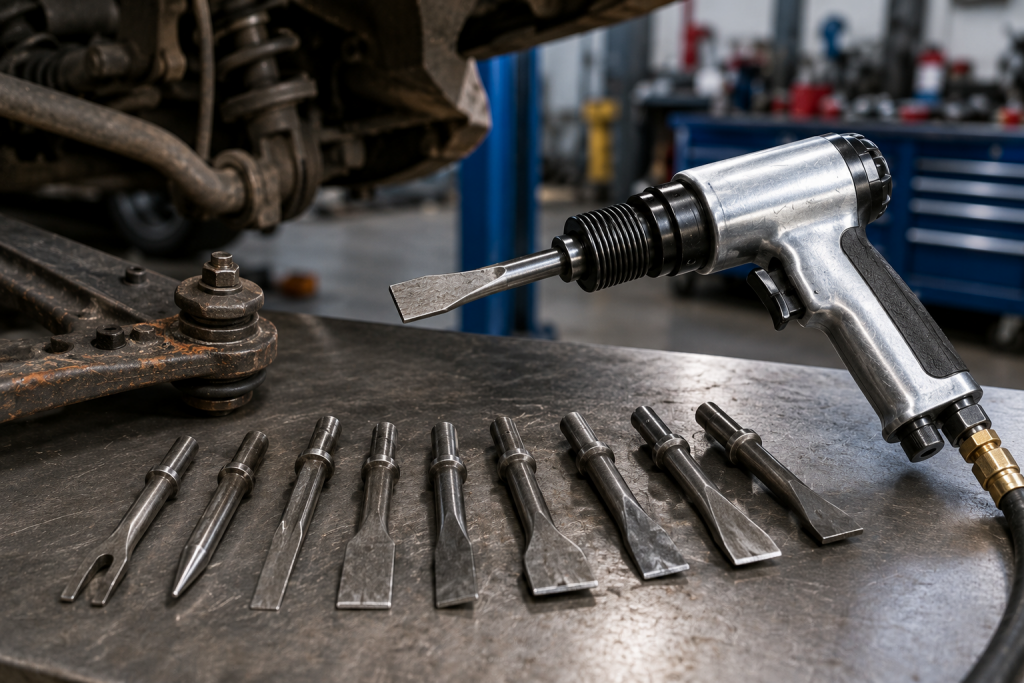
An air hammer is a handheld pneumatic tool used to cut, separate, drive, scrape, chip, and shape material with rapid linear blows. Common jobs include freeing seized automotive parts, separating ball joints, cutting exhaust tubing and sheet metal, removing rivets and pins, scraping corrosion, and chipping tile or small areas of concrete. The correct bit and the air hammer’s specifications determine which jobs it can handle safely.
Before choosing a hammer, compare its airflow demand with the air-tool CFM chart. For cutting rather than chipping or separating parts, see our explanation of cut-off tools and wheels.
Common Air Hammer Uses at a Glance
| Task | Recommended bit or attachment | Key caution or better alternative |
|---|---|---|
| Separate a ball joint or tie-rod end | Fork separator | Protect the rubber boot and threads. Use a puller when the joint must be reused. |
| Free a seized component | Blunt hammer tip or tapered punch | Apply short bursts away from machined and threaded surfaces. |
| Drive out a pin | Tapered or pilot punch | Support the assembly and match the punch diameter to the pin. |
| Cut an exhaust pipe or clamp | Tailpipe cutter or panel-cutting chisel | Check behind the cut for fuel lines, brake lines, wiring, and heat shields. |
| Cut sheet metal | Panel cutter or sheet-metal chisel | Control the cut to avoid tearing the panel or damaging hidden components. |
| Break spot welds | Spot-weld breaker | Confirm the weld location and avoid cutting through both panels. |
| Remove rivets | Rivet cutter or punch | Use the correct purpose-built riveting tool when setting new rivets. |
| Scrape rust, scale, adhesive, or undercoating | Wide scraper | Reduce pressure near finished surfaces and thin sheet metal. |
| Remove tile or thinset | Wide chisel or scraper | Use shallow angles. A rotary hammer is usually better for large areas. |
| Chip mortar or light concrete | Masonry chisel | Limit use to small work. Choose a rotary or demolition hammer for substantial removal. |
What Is an Air Hammer and How Does It Work?
An air hammer, also commonly called an air chisel or pneumatic hammer, connects to an air compressor through a hose and air inlet. Compressed air moves a piston inside the tool. The piston repeatedly strikes the retained bit, producing rapid forward blows.
Unlike an impact wrench, an air hammer does not rotate a socket or fastener. Its force travels in a straight line through a chisel, punch, separator, scraper, cutter, or driver. That action makes it useful when a part must be cut, driven, loosened, separated, or shaped.
Blows per minute, or BPM, describes how frequently the piston strikes. BPM alone does not establish how powerful the tool is. Stroke length, piston design, air pressure, air consumption, bit geometry, and the material being worked all affect performance.
Automotive Uses for an Air Hammer
Automotive repair is one of the most practical applications for an air hammer. It can deliver concentrated impact in spaces where swinging a hand hammer is difficult, but it must be used with control. A powerful attachment in the wrong position can damage a reusable part, deform sheet metal, or strike a component hidden behind the work area.
Exhaust and Sheet-Metal Cutting
With a tailpipe cutter or panel-cutting chisel, an air hammer can cut corroded exhaust tubing, split stubborn clamps, and open damaged sheet metal. It can also help remove sections of a body panel when the surrounding structure is being repaired or replaced.
Inspect both sides of the work area before cutting. Exhaust systems often sit near heat shields, wiring, brake lines, fuel-system components, and other parts that should not be touched by the bit. Use controlled passes instead of forcing the cutter through the material in one spot.
For occasional exhaust or panel work, a standard-duty air hammer kit shows the type of tool-and-bit package to compare. Confirm the included bits, shank size, operating pressure, and air consumption against the current product specifications before selecting a kit.
Ball Joints, Tie Rods, Bushings, and Seized Parts
A fork separator can help release certain ball joints and tie-rod ends. A blunt hammer tip can transmit vibration into a surrounding component, while a punch or driver can move a pin or bushing after the assembly has been supported correctly.
A front-end pneumatic separator set provides task-specific profiles for suspension work. Choose a fork width that fits the joint and remember that a fork can damage the rubber boot. When the joint will be reused, or when nearby aluminum components could be marked or distorted, a screw-type separator or puller may offer better control.
Bushings also require care. An air hammer can help remove some worn bushings with the correct splitter or driver, but it is not a substitute for supporting the assembly. A press or dedicated removal tool is the safer choice when the housing can bend or when the replacement part must be installed squarely.
Rivets, Pins, and Bodywork
A rivet cutter or punch can remove old rivets, while a properly sized pilot punch can drive out pins without slipping as easily as a general-purpose chisel. These pneumatic pilot punches are examples of attachments designed for pin-removal work.
Removing a rivet and setting one are different operations. For solid rivets, use the proper solid-rivet gun or hammer and bucking method. For blind rivets, use a compatible blind-rivet tool. A general-purpose air hammer should not automatically be treated as a substitute for either system.
Body technicians may also use specialized attachments for breaking spot welds, shaping accessible sheet metal, or performing rough panel work. These jobs call for moderate trigger control and careful backing support. Finished exterior surfaces usually require dedicated body hammers, dollies, or other tools that provide finer control.
Metalworking and Light Demolition Uses
In fabrication and maintenance work, an air hammer can cut light-gauge metal, trim damaged sections, remove slag, scrape rust or scale, and perform limited shaping. Flat chisels and panel cutters concentrate force at an edge. Wide scrapers spread the force across a larger surface for coatings, gasket residue, and corrosion.
The tool can also remove tile, thinset, or small sections of mortar and concrete. Hold a wide chisel at a shallow angle for surface removal so it works beneath the material instead of driving deeply into the substrate.
An air hammer is best suited to localized impact work. For removing a room of tile, drilling masonry, or breaking a substantial slab, use a rotary hammer or demolition hammer designed for sustained masonry work.
Which Air Hammer Bit Do You Need?
The attachment determines what the air hammer does. Do not choose a bit by appearance alone. Check its intended application, nominal shank diameter, length, material, and retainer requirements.
- Flat chisel: Cuts, splits, or chips suitable metal and light masonry.
- Panel cutter: Produces a directed cut through suitable sheet metal or exhaust material.
- Tapered punch: Drives out pins and helps align or separate parts.
- Pilot punch: Centers more securely on a correctly sized pin.
- Fork separator: Separates certain ball joints and tie-rod ends.
- Spot-weld breaker: Helps separate welded automotive panels.
- Wide scraper: Removes scale, coatings, adhesive, thinset, or gasket material.
- Blunt hammer tip: Delivers vibration and impact without a cutting edge.
- Rivet cutter: Cuts or removes existing rivet heads.
- Bushing splitter or driver: Assists with compatible bushing-removal work.
A .401-inch chisel and cutter set may cover several common cutting and chipping jobs, but the .401 designation must match the air hammer and its retainer. Never assume an attachment fits because it can be partially inserted.
How to Choose the Right Air Hammer
Start with the work, not the highest advertised BPM. Consider the material, access, required control, frequency of use, available compressor output, and attachments you expect to run.
Readers comparing complete packages can review air hammer kits, while those choosing a tool separately can compare the broader selection of air hammers for automotive and shop work.
Short Barrel vs. Long Barrel
A short-barrel air hammer is often easier to control and position in confined spaces. It can be a practical choice for lighter cutting, scraping, and general repair work.
Within a comparable product family, a longer stroke is commonly selected for harder-hitting suspension, exhaust, and separation work, while a shorter stroke may deliver more blows per minute. Barrel length and BPM alone do not establish impact power, so compare stroke, impact data, intended applications, and air demand.
A long-barrel air hammer kit is the type of option to consider for more demanding suspension or chassis tasks. Review the manufacturer’s current specifications before treating barrel length as a power rating by itself.
.401 and .498 Shank Compatibility
.401-inch and .498-inch figures describe nominal round-shank sizes. .401-inch shanks are common on general-purpose automotive air hammers, while some larger or specialty tools use .498-inch shanks. The sizes are compatibility specifications, not standalone measures of hitting power, and they are not interchangeable.
The bit, tool barrel, and retainer must form an approved system. A .498-inch quick-change retainer, for example, should be used only with a tool and attachments specified for that shank system. Check the air hammer manual and retainer instructions before ordering bits.
Inspect retainers and springs for wear. A retainer that does not secure the bit correctly can allow the attachment to loosen or leave the tool during operation.
Match PSI and CFM to the Specific Model
There is no single compressor size that fits every air hammer. Follow the exact tool specification and size the compressor by the required CFM or SCFM at the specified pressure and by the expected duty cycle.
Check whether the published airflow figure is an average-use number or a continuous or full-load requirement. A compressor’s maximum PSI does not show how much air it can supply continuously. Compare delivered airflow at the required pressure with the tool manufacturer’s rating, using equivalent measurement terms when possible.
Tank capacity affects stored-air run time and how often the compressor cycles. Compressor output determines whether the system can sustain the work. Long cuts, scraping, and demolition consume air for longer periods than short bursts used to free a part.
Also check the manufacturer’s hose-diameter and inlet recommendations. A restrictive hose, undersized fitting, leak, or long run can reduce pressure and airflow at the tool. Measure or set pressure as the manufacturer directs, and never exceed the tool’s rated maximum.
When Is Another Tool Better?
| Job | Better tool | Why |
|---|---|---|
| Setting solid rivets | Purpose-built solid-rivet gun or hammer | Provides controlled percussive action for the specified rivet and bucking method. |
| Installing blind rivets | Blind-rivet tool | Pulls the mandrel using the mechanism intended for the fastener. |
| Removing large areas of concrete or masonry | Rotary or demolition hammer | Designed for sustained masonry drilling, chipping, or breaking. |
| Threaded fasteners | Impact wrench | Applies rotational impact through a socket. |
| Removing reusable joints or pressing bushings | Puller, separator, or shop press | Applies aligned force with less impact damage. |
| Working on finished or delicate surfaces | Hand tools or specialty body tools | Reduces the risk of dents, gouges, and uncontrolled cuts. |
How to Use an Air Hammer Safely
Air hammers create impact, noise, vibration, and flying debris. The correct precautions depend on the tool, attachment, material, and work environment.
- Wear the required protection. Use impact-rated eye protection and hearing protection. Add face, respiratory, hand, foot, or head protection as the material and task require.
- Inspect the setup. Do not use a damaged tool, hose, retainer, or accessory. Replace worn, cracked, distorted, mushroomed, or blunt chisels.
- Secure the work. Support the workpiece, keep hands out of the accessory path, and never hold the chisel with the free hand.
- Disconnect before changes. Shut off the air, bleed residual pressure, and disconnect the hose before installing, removing, adjusting, or maintaining an accessory.
- Use the correct retainer and pressure. Confirm that the attachment is properly retained. Follow the tool manual and never exceed rated pressure.
- Control the tool. Use a light but secure grip and start with short, controlled bursts. Do not run the tool unless the accessory is properly installed and held against the work.
- Watch vibration exposure. Change posture during extended work and stop if numbness, tingling, pain, or finger whitening occurs.
- Control hazardous dust. Chipping concrete or masonry can create respirable silica. Follow material-specific controls and applicable workplace requirements.
Frequently Asked Questions
Is an Air Hammer the Same as an Air Chisel?
In common handheld-tool usage, the terms air hammer and air chisel often describe the same pneumatic tool. Manufacturers may use the names differently across product lines, so the model specifications and compatible attachments remain the better guide.
What Size Air Compressor Do I Need for an Air Hammer?
Choose a compressor that meets the air hammer manufacturer’s rated airflow at the specified pressure for the expected duty cycle. Confirm whether the listed CFM or SCFM is an average or full-load figure. Do not select a compressor by tank gallons alone.
Can an Air Hammer Cut Metal?
Yes. With a suitable panel cutter, tailpipe cutter, or flat chisel, an air hammer can cut compatible sheet metal, exhaust components, and other metal workpieces. The practical limit depends on the tool, bit, material, thickness, and access.
Can an Air Hammer Break Concrete or Remove Tile?
An air hammer can chip small, localized areas of concrete and remove tile, mortar, or thinset with a suitable chisel or scraper. A rotary hammer or demolition hammer is usually more efficient for drilling masonry, removing large tiled areas, or breaking substantial concrete.
Can an Air Hammer Remove Ball Joints and Bushings?
It can assist with compatible ball joints, tie-rod ends, bushings, and seized suspension parts when the correct separator, splitter, or driver is used. Support the assembly and use a puller or press when the component must be reused or the housing could be damaged by impact.
What Is the Difference Between an Air Hammer and a Riveting Tool?
A general-purpose air hammer is intended mainly for cutting, removal, separation, and impact work. A solid-rivet gun or hammer is built to set solid rivets with the specified bucking method, while a blind-rivet tool pulls a mandrel. Use the tool designed for the rivet system.
Choose the Right Air Hammer Setup
A useful air hammer setup combines the correct tool, attachment, retainer, hose, and compressor output for the job. Start with the application, verify every compatibility and air-demand specification, and choose a more controlled tool when impact could damage a reusable part. Browse air hammers at National Tool Warehouse to compare options for automotive, fabrication, and shop work.