
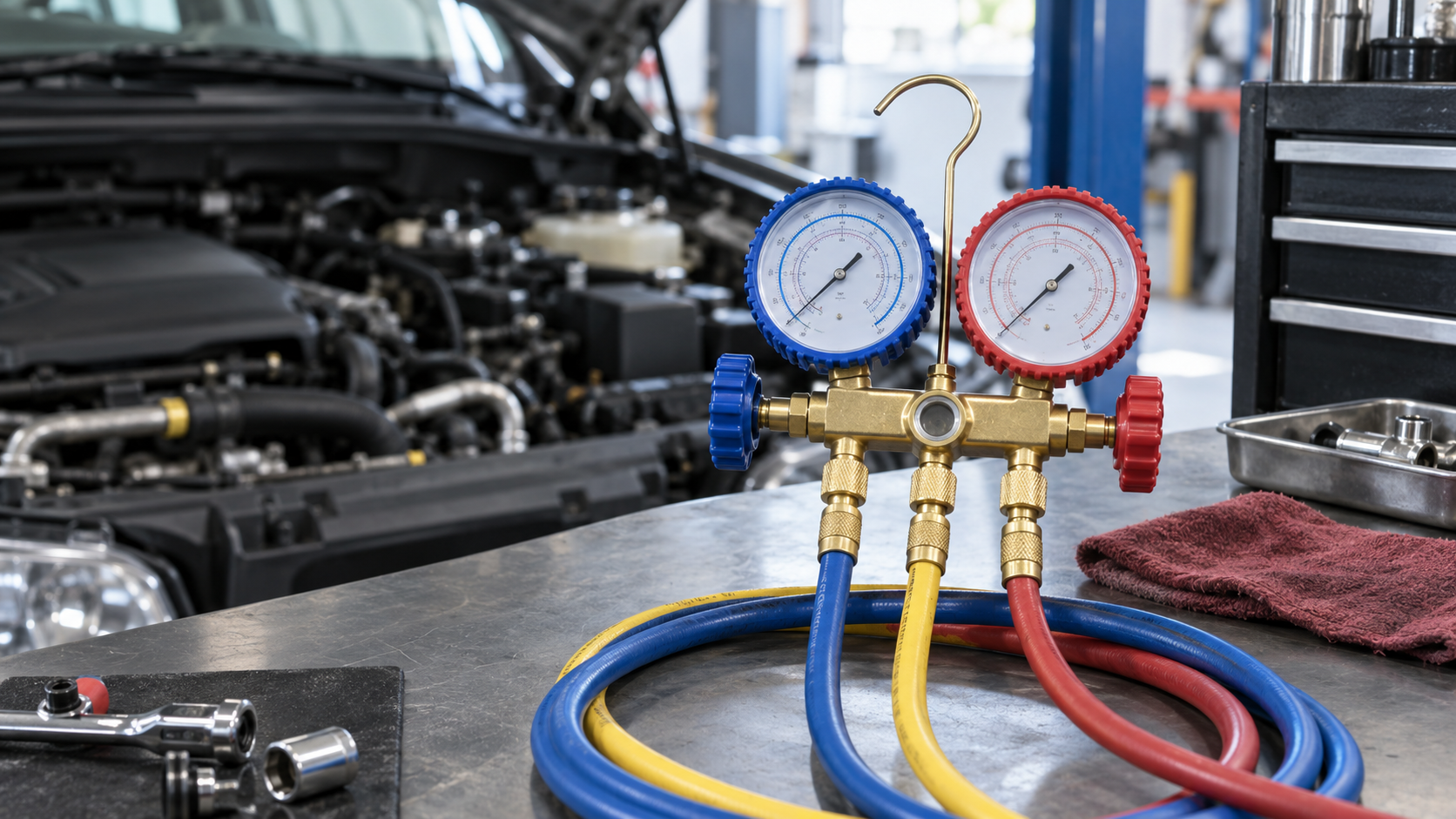
An automotive A/C manifold set shows pressure at the low and high sides of a system. The blue gauge is usually the low side and the red gauge the high side; the center hose is used with service equipment. These readings can help a trained technician investigate a cooling complaint, but a single pressure number is not a refrigerant charge measurement or a diagnosis by itself.
Know what the gauges show
The low side is the suction side of the system; the high side is the discharge side. Gauge scales may show pressure and a corresponding saturation temperature for a named refrigerant. That temperature scale is valid only for that refrigerant. A reading has to be interpreted against the vehicle’s refrigerant, ambient conditions, system operating state and the manufacturer’s service information.
| Observation | What it can tell you | What it cannot prove |
|---|---|---|
| Both sides equalized with the system off | The system has reached a static pressure state. | That the charge mass is correct. |
| Low and high sides differ while operating | The compressor is creating a pressure difference. | The cause of poor cooling from pressure alone. |
| Unexpected readings | More checks are needed. | That adding refrigerant is the right repair. |
Confirm the refrigerant and fittings first
Read the vehicle’s under-hood label and service information. R-134a and R-1234yf equipment is not interchangeable simply because the hoses look similar. The EPA’s motor vehicle A/C servicing guidance explains the requirement for refrigerant-specific fittings and warns against changing adapters between refrigerants. Use equipment designed for the identified system; never force a connector.
Readings need context
Record ambient temperature, vent temperature, engine and blower settings, and whether the compressor and cooling fans are running. Compare the gauge pattern with the exact vehicle’s service procedure and refrigerant pressure-temperature information. A restriction, airflow problem, control fault or incorrect charge can produce overlapping symptoms. Gauges are one part of diagnosis, alongside inspection, leak detection and the manufacturer procedure.
Safe handling and when to use a professional
Refrigerant is pressurized. Wear the protection specified for the service equipment, follow the gauge-set manual, and keep hands clear of moving engine components. Do not vent refrigerant, mix types or use pressure readings as a shortcut for charging by weight. In the United States, EPA Section 609 certification is required for anyone servicing motor vehicle A/C for payment or barter, and approved handling equipment is required. A qualified shop should handle recovery, repair and recharge where the job requires opening or emptying the system.
Explore A/C tools and automotive A/C manifold sets at National Tool Warehouse. Select gauges and fittings that match the refrigerant and the work you are qualified to perform.