
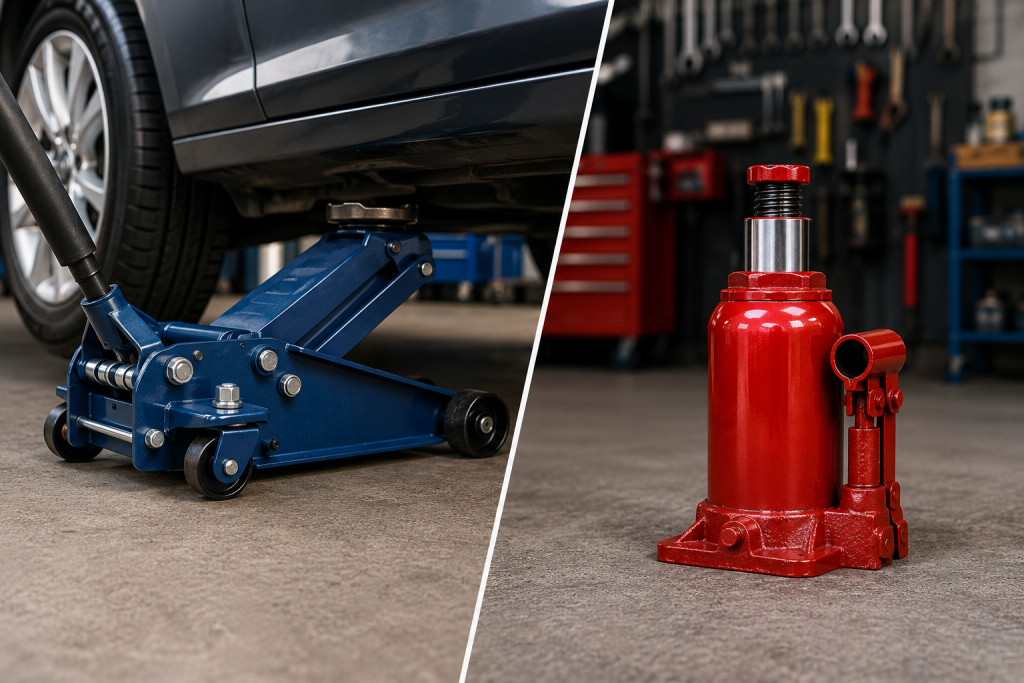
For most routine work in a home garage, a floor jack is the more convenient choice. Its low body fits under many passenger vehicles, its long handle makes positioning easier, and its broad footprint feels steady on a smooth shop floor. A bottle jack is usually the better fit when compact storage, high load ratings, or access under a taller truck, trailer, or piece of equipment matters more.
Plan the rest of the job as well as the lift: our garage hand-tools checklist helps organize the tools you will need, and our torque-wrench guide explains controlled tightening during reassembly.
That is the short answer, but the right choice always comes down to the specifications of the exact jack and vehicle. Rated capacity, collapsed height, maximum height, saddle fit, lift point, and ground conditions matter more than the jack’s shape alone. Also remember the essential safety distinction: a jack lifts the vehicle; appropriately rated stands support it while you work.
Floor Jack vs. Bottle Jack at a Glance
Use this comparison as a starting point, then verify the product label, jack manual, and vehicle owner’s manual before lifting.
| Feature | Floor jack | Bottle jack |
| Design | Low horizontal body, long handle, saddle, and casters | Compact vertical hydraulic cylinder with a small base |
| Vehicle clearance | Often available in low-profile designs | Usually needs more clearance under the lift point |
| Capacity | Varies widely by model | Varies widely; compact models often offer high ratings |
| Positioning | Rolls under the vehicle and can reach farther inboard | Fits near accessible lift points but has less reach |
| Stability | Broad footprint on a smooth, hard floor | Smaller footprint makes placement and surface quality critical |
| Portability | Heavier and bulkier to move or store | Compact and easier to carry |
| Best fit | Frequent garage service, low cars, tires, brakes, suspension work | Taller vehicles, trailers, heavy equipment, mobile storage |
How Floor Jacks and Bottle Jacks Work
What is a floor jack?
A floor jack, also called a service jack or trolley jack, uses a hydraulic cylinder mounted in a low horizontal chassis. Pumping the long handle raises a lifting arm and saddle. Casters let the jack move slightly as the arm travels through its arc, which is why a floor jack needs a hard, smooth surface and room to roll.
The low body and long reach make a floor jack useful for passenger cars and for lift points located farther under the vehicle. National Tool Warehouse carries floor jacks and hydraulic service jacks in multiple capacities and height ranges.
What is a bottle jack?
A bottle jack places its hydraulic cylinder upright. The piston rises vertically from a compact base, and many models include an adjustable extension screw that closes part of the gap to the load. The design packs substantial lifting force into a small footprint, so it is common in truck, trailer, farm, construction, and equipment service.
The tradeoff is fit. A bottle jack may be too tall to slide under a low car, especially when a tire is flat, and its smaller base demands careful placement. Browse bottle jacks by rating, minimum height, maximum height, base size, and operating method.
The Differences That Matter
Rated capacity
Do not assume that every bottle jack carries more than every floor jack, or that a higher tonnage label automatically makes a jack suitable for your vehicle. Both designs are sold in a wide range of ratings. The rating must be sufficient for the load applied at the approved lift point, and the jack must be used within the conditions stated by its manufacturer.
Check the vehicle owner’s manual for approved lift points and vehicle-specific instructions. Then compare the jack’s label and manual with the actual lifting task. Avoid universal rules such as buying solely from curb weight or choosing a fixed percentage of gross vehicle weight. The load at one corner, one axle, or one end depends on the vehicle and the lift configuration.
Minimum height, lifting travel, and maximum height
These terms are easy to confuse. Minimum or collapsed height is the shortest distance between the ground and the saddle. Lifting travel is how far the hydraulic mechanism moves. Maximum height is the highest saddle position, sometimes including an extension screw or adapter.
A jack can have plenty of capacity and still be the wrong tool if it will not fit under the lift point or cannot raise the vehicle enough to place stands. Measure with the vehicle in the condition in which you may use the jack. A flat tire can lower the body or axle enough to rule out a bottle jack that normally fits.
Stability, saddle contact, and positioning
A floor jack’s wider chassis and low center of gravity usually make it easier to position on a shop floor. Its long handle also helps reach lift points without placing your body too far under the vehicle. The casters are part of the design, not a convenience alone. They allow the jack to follow the lifting arc instead of pulling the saddle across the lift point.
A bottle jack lifts more directly upward but has a narrower base and shorter reach. Confirm that the base sits fully on a firm, level foundation and that the saddle contacts the approved lift point securely. Use only manufacturer-approved adapters or extensions. Improvised blocks can shift, split, or change the load path.
Speed, portability, and storage
For repeated garage work, a floor jack is usually faster to roll into place and pump. The downside is weight and storage space. A bottle jack is easier to carry in a truck or service vehicle and can live on a shelf or in a toolbox, although it still needs protection from damage, contamination, and fluid leakage. Inspect either type before use and maintain it according to the manual.
Which Jack Should You Choose?
Passenger cars and low-clearance vehicles
Start with a low-profile floor jack that fits the approved lift point and reaches the required height. A conventional bottle jack often cannot get under a sedan, sports car, or lowered vehicle, especially with a deflated tire. Do not create clearance by stacking loose lumber or other improvised material under the jack.
SUVs, pickups, and lifted trucks
A bottle jack can be a practical choice when the vehicle provides enough clearance and the lift point is accessible. Its compact size also suits a recovery or mobile service kit. In a garage, however, a long-reach floor jack may still be easier to position under a frame or axle and quicker for frequent tire, brake, or suspension work. Check maximum height as carefully as capacity because suspension droop can demand more lift than expected.
Home garage and professional shop
For frequent vehicle maintenance, a floor jack paired with correctly rated stands is the most versatile setup. Shops working on heavy trucks, trailers, or equipment may also need bottle jacks, air-assisted bottle jacks, axle jacks, or other task-specific lifting equipment. Owning both types is sensible when each has a clearly defined job.
Once the vehicle is securely supported, you may need various auto body tools to complete your repairs. If you are outfitting your space, it is also worth researching which power tool brand is best for your specific needs.
Roadside and mobile kits
Portability favors the bottle jack, but roadside conditions can work against any jack. Confirm that the jack fits when the tire is flat, can reach the specified lift point, and can achieve the height needed for the wheel to clear. Use the vehicle’s supplied procedure, move away from traffic when possible, and never crawl under a vehicle during a roadside tire change.
How to Choose the Right Jack
- Find the approved lift points. Use the vehicle owner’s manual. Some vehicles require specific pads, adapters, or settings before lifting.
- Confirm the rated load. Match the jack and stands to the actual lifting configuration and never exceed any equipment label.
- Measure minimum clearance. Check the lowest likely condition, including a flat tire or loaded vehicle.
- Verify maximum height. Make sure the jack can raise the vehicle enough to place stands at approved support points.
- Check saddle compatibility. The contact surface should seat securely without damaging the vehicle or slipping.
- Plan for the surface. A floor jack needs space for its casters to roll. Either design needs a firm, level foundation.
- Match the support equipment. Select rated jack stands and wheel chocks that fit the vehicle, height, and work area.
- Consider frequency and storage. A floor jack favors repeated garage use; a bottle jack favors compact transport and specific high-clearance jobs.
Safe Lifting Rules for Either Jack
A jack is a lifting device, not a support stand. If a vehicle must remain raised for service, transfer the load to appropriately rated jack stands at approved support points before beginning work.
The OSHA jack standard requires sufficient rated capacity, secure foundations and load contact, and proper inspection and maintenance in workplace use. A NIOSH-indexed vehicle-jacking safety tip sheet also emphasizes the parking brake, wheel chocks, firm level ground, approved lift points, rated stands, and removal of worn or damaged equipment from service.
- Read the jack, stand, and vehicle instructions before lifting.
- Inspect the jack and stand for leaks, damage, deformation, missing labels, or unusual operation.
- Park on a firm, level surface. Do not casually use either jack on gravel, dirt, a slope, or soft asphalt.
- Set the parking brake, select Park or the appropriate gear, and chock the wheels that remain on the ground.
- Center the saddle on the approved lift point and watch the contact as the vehicle rises.
- Lower the vehicle onto rated stands before working around or beneath it.
- Keep people out of the vehicle and away from the load while lifting or lowering.
- Stop if the jack leans, the base shifts, the saddle slips, or the vehicle behaves unexpectedly.
For more shop safety tips, consider checking out a toolbox talk to keep your workspace secure.
Shop Floor Jacks, Bottle Jacks, and Stands
The best jack is the one that fits the vehicle, lift point, job, and work area. Compare National Tool Warehouse’s full range of automotive lifting equipment, including floor jacks, bottle jacks, jack stands, axle jacks, and shop lifting accessories. Check the current product specifications before ordering, and choose support equipment at the same time as the jack.
Frequently Asked Questions
Is a floor jack safer than a bottle jack?
A floor jack usually provides a wider footprint and easier positioning on a smooth shop floor, but neither design is safe by category alone. Correct capacity, secure saddle contact, a firm level foundation, approved lift points, and rated stands determine whether the setup is appropriate.
Can a bottle jack lift a car?
Yes, if the bottle jack has sufficient rated capacity, fits under the approved lift point, seats correctly, and reaches the required height. Many low-clearance cars do not leave enough room for a conventional bottle jack, particularly with a flat tire.
Which jack is better for a truck or SUV?
For a mobile kit or an accessible lift point on a high-clearance vehicle, a bottle jack can be compact and capable. For repeated shop work, a long-reach floor jack may be easier to position and operate. Compare minimum height, reach, maximum height, saddle fit, and capacity for the exact vehicle.
What jack capacity do I need?
Use the vehicle owner’s manual, the jack manufacturer’s instructions, and the actual lift configuration. Choose a jack and stands rated for the load they will carry, with appropriate margin, and never exceed the marked capacity. Do not rely on one universal tonnage formula.
Do I need jack stands?
Use appropriately rated stands whenever the vehicle must remain raised for inspection, maintenance, or repair. Place them only at approved support points. Never work under a vehicle supported only by a hydraulic jack.
Can I use a floor jack or bottle jack on gravel or soft asphalt?
Do not assume either design is suitable. Jacks need a firm, level foundation, and a floor jack’s wheels must be able to roll as it lifts. Follow the manufacturer and vehicle instructions. If the surface cannot provide a stable foundation, move the vehicle or use equipment and procedures specifically approved for that environment.